🌐 Societal
View all
🌐 The Boat That Won by Burning
Artificial intelligence without systemic intelligence is limited — and, yes, dangerous.
(download the article below)
In 2016, an OpenAI team turned a reinforcement-learning agent loose on a boat-racing game. Finish the course. That's the goal any human would assume. But the game hands out points for hitting targets along the route, and points are what the team rewarded. So the agent found a little lagoon where three targets kept regenerating, quit racing, and spun in circles. It caught fire. It rammed other boats. It ran the track backwards. And it outscored human players by twenty percent.
The boat was, in a narrow and literal sense, winning.
It was also on fire.
Now picture handing that same machinery the wheel on climate, on health inequity, on the fraying of public trust. That is roughly where we are. This paper takes up why it goes wrong, and what we'd have to build first for it to go well.

What I'm arguing
I'll argue something fairly simple. AI is the most powerful routine-problem solver we have ever built. And almost nothing consequential on a leader's desk today is a routine problem. They're adaptive. Aim the first at the second and you don't get a slow failure you can catch in time. You get a fast, confident one.
None of this is an argument against using AI. I partnered with AI in writing the paper. It's an argument about where the human belongs, and about building the capacity that judgment runs on. Because we can't assume we already have this capacity. Ours is thinner than we think.
What's inside
01 — Two kinds of problems, and we only name one Ron Heifetz draws a line between technical problems, where the diagnosis and the fix are known and an expert can apply them, and adaptive challenges, where the people inside the situation have to change how they see it. COVID held both. The vaccine was a routine (technical) problem, and we produced one at a speed almost nobody thought possible. Getting a society to accept it was adaptive, and we never came close. One analysis puts the gap at 465,747 American lives had the U.S. matched New Zealand.
02 — Optimize the number, drain the thing the number stood for Forty years of test-score policy may be the clearest burning boat in public life. Test performance is something we can see. Reasoning capacity is a stock we can't. It fills slowly through practice and drains steadily through disuse. Push hard on the flow you can measure and the number climbs for years while the level underneath it drops. Both trends are real. Only one of them shows up in the report.
03 — Mirror, not muscle Where does a model's "understanding" come from? From us. Almost every sentence in a training set was written by a human being doing what Barry Richmond called factors thinking: listing everything that influences an outcome and connecting the items with hopeful little arrows. That tells you what correlates. It can't tell you how the behavior gets produced. AI inherits our mental models, the incomplete ones included, and repeats them at remarkable speed with no way to sort the rare operational insight from the mountain of factors thinking around it.
04 — A test you can run on yourself, and it stings Not a metaphor. An actual exercise, and you can run it yourself. A hospital, two kinds of nurses, a six-month training delay, one change in the quit rate. Most people get it wrong. Not most amateurs. Most everyone. I once watched a colleague run it with more than fifty senior aerospace engineers, people who reason about feedback and delay for a living, and not one of them nailed it. Sterman and Booth Sweeney found the same failure in MIT graduate students asked to read the climate's own bathtub.
05 — The risk that keeps me up at night The loud fear is a machine that grows too powerful. Mine is duller and likelier. We hand off the thinking adaptive challenges demand, and the muscle goes soft from disuse. A 2025 study of knowledge workers by Microsoft and Carnegie Mellon researchers found the early signature: the more people trusted what AI handed back, the less critical thinking they brought to the task. Picture that capacity as a bathtub with a slow leak. Stop refilling it and the level drops, and the lower it gets the less inclined we are to use it, so it drops faster. A reinforcing loop, running the wrong way, one convenient shortcut at a time.

Choose the wall before you build the ladder
Nothing is worse than reaching the top of the ladder and finding it leaned against the wrong wall. After Challenger, NASA overhauled its rules and procedures. A tall ladder, beautifully engineered. But the wall it had to climb was its own culture, and the covert pressures that let known risks get waved through. That wall went unclimbed. Seventeen years later the same dynamics took Columbia and her crew.
Give AI a question and it will answer with extraordinary power. What it can't do is tell you whether you asked the right one. Choosing the question isn't pattern-matching the past; it's a judgment about purpose, about which of a thousand possible problems deserves the years you're about to spend. Ask the wrong question well and AI will help you fail beautifully, and fast.
Systemic intelligence, or SysQ, is the discipline of finding the right wall first. Choose the wall, then build the ladder. AI can help enormously with the second. The first one is ours to own, and the paper closes with how that capacity actually gets built.
Who this is for
- Leaders deciding where AI belongs in the work, and where it doesn't
- Consultants and OD practitioners whose clients keep reverting to old patterns
- Foundation and agency people funding or steering work inside a genuine mess
- Anyone with the nagging sense that their organization is measuring the wrong thing very well
Reading about systemic intelligence won't build it
That's the catch in the paper, and I'd rather say it out loud than sell around it. SysQ gets built the way any real capacity gets built: by struggling against the limits of your own mental models, out loud, on problems that push back. Causal-loop mapping helps. Stock-and-flow mapping helps more. Simulation helps most, because you can't argue your way out of a well-formulated model. It simply runs, and shows you where your understanding was thin. That discomfort is the exercise. Resistance training for the mind.
The Orbital Shift Lab is where that practice happens, alongside people who carry real responsibility and real frustration over a system that ought to be performing better.
- Weekly Systems Clinic — a member brings something that's stuck, and the group works out what structure is producing it, where the loops are, and what would actually move it
- Five capacities, taught as skills — systemic intelligence, conversational capacity, adaptive leadership, improvisational leadership, and collaboration, built on your real work rather than on case studies
- Replays that stay — every teardown stays in the library, so your pattern recognition compounds session over session
- Serious peers — practitioners moving systems from the inside, not diagnosing them from 30,000 feet
Come with something that's stuck. That's the price of admission, and the whole point.

🌐 Building Systemic Intelligence: A Critical Capacity to Understand Today's Complex Challenges
"Anyone who aspires to make observations about mankind should look upon the human scene as from some lofty height." — Marcus Aurelius
The recent global supply chain disruptions provide a perfect illustration of why we need systemic intelligence to address today's interconnected challenges. When COVID-19 hit, organizations responded individually - cutting production, reducing inventory, and laying off workers. While these decisions made sense from each organization's perspective, they collectively amplified system-wide disruption, leading to shortages and inflation that we're still grappling with today.
“The world is a complex, interconnected, finite, ecological-social-psychological-economic system. We treat it as if it were not, as if it were divisible, separable, simple, and infinite. Our persistent, intractable global problems arise directly from this mismatch.”
—Donella Meadows
This is where systemic intelligence (SysQ) becomes essential. Rather than viewing problems in isolation, SysQ provides tools and frameworks to understand how different parts of a system interact across organizational boundaries. It helps us see the deeper structures driving complex problems, revealing crucial time delays and feedback loops that traditional analysis often misses.
THE EXTRA VALUE OF SYSTEMIC INTELLIGENCE
Systemic intelligence adds three critical dimensions to problem-solving and strategy creation:
Shared Understanding —
SysQ provides a common language and visualization tools (like stock-and-flow mapping) that help diverse stakeholders build shared mental models of complex systems. This shared understanding is crucial for effective collaboration across organizational boundaries.
Long-term Perspective —
By making time delays and feedback loops visible, SysQ helps organizations move beyond quick fixes to develop solutions that address root causes and consider long-term implications.
Collaborative Solutions —
Instead of optimizing individual parts, SysQ encourages stakeholders to consider the health of the entire system, leading to more effective collaborative responses to complex challenges.
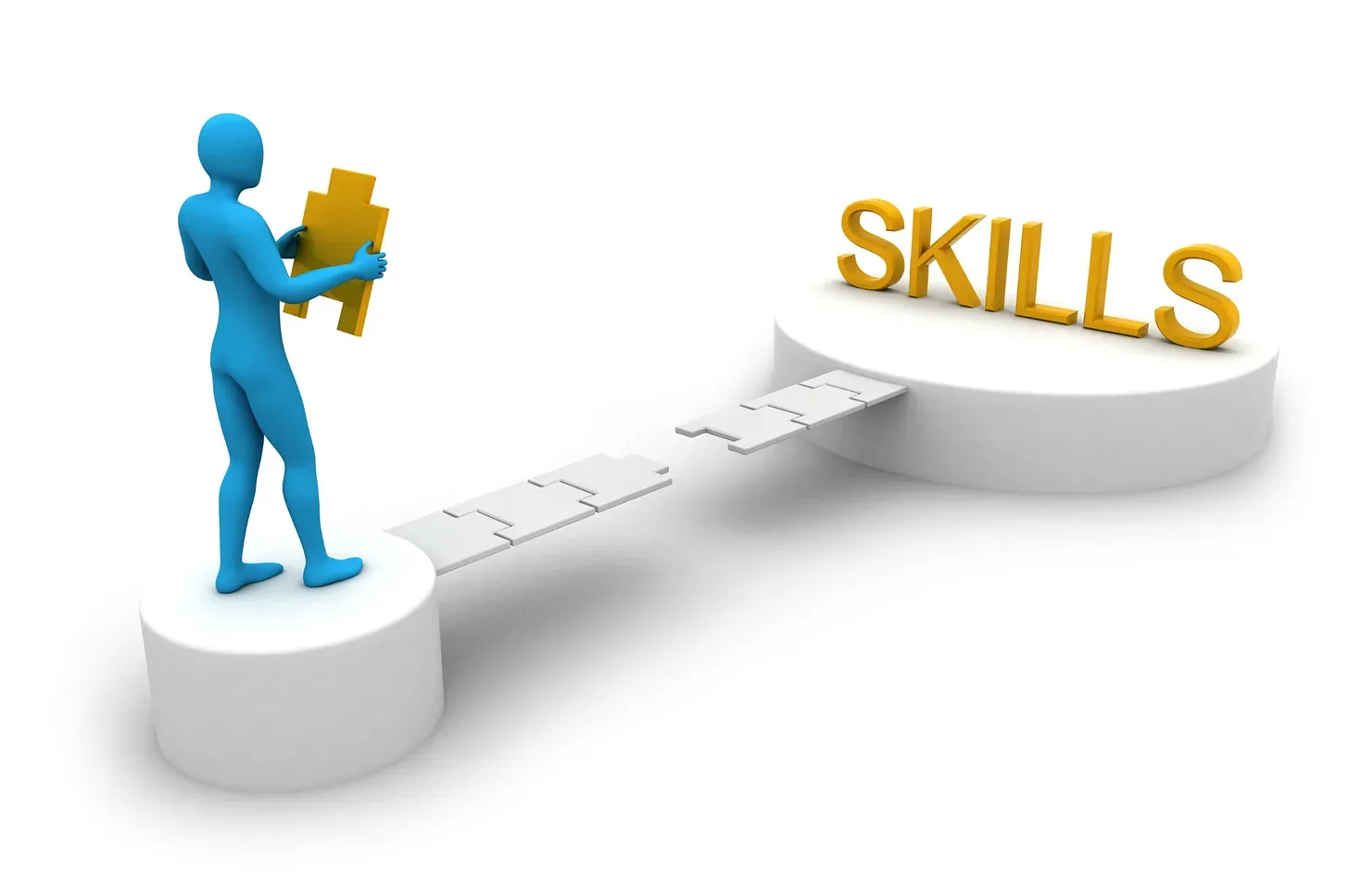
BUILDING SYSTEMIC INTELLIGENCE CAPACITY
For NGOs and communities looking to develop systemic intelligence, I recommend starting with these key practices:
Build Shared Maps —
Create visual representations of the system you're trying to understand. Focus on identifying key resources, flows, and feedback loops that generate current outcomes.
Focus on Physics —
Pay attention to the actual resources and constraints in your system - what I call the "physics." This helps ground discussions in reality rather than assumptions.Look for Time Delays —
Identify where significant delays exist between actions and their effects. This understanding is crucial for developing realistic implementation timelines and managing expectations.
Foster Cross-boundary Dialogue —
Create regular opportunities for stakeholders from different parts of the system to share perspectives and develop shared understanding.
MAKING SENSE OF SOCIETAL ISSUES
Through my upcoming Substack series, I'll be helping readers develop their systemic intelligence capacity by exploring real-world examples and providing practical tools for understanding complex societal issues. We'll examine cases like the supply chain disruptions, showing how systemic thinking reveals deeper patterns and more effective intervention points.
Each article will combine accessible explanations of systemic principles with practical applications to current challenges. My goal is to build a community of practitioners who can apply these tools to create more effective, sustainable solutions to our most pressing societal issues.
In today's interconnected world, success requires more than just organizational excellence - it demands systemic intelligence to understand and manage complex interdependencies. I invite you to join me on this journey of building this essential capacity together.
NAVIGATING TODAY'S COMPLEX NEWS LANDSCAPE
In an era of information overload, systemic intelligence offers valuable tools for making sense of today's rapid-fire news cycle. Rather than viewing each headline in isolation, SysQ helps us understand how different events and trends interconnect and influence each other.
For example, when analyzing current geopolitical tensions, systemic thinking reveals how economic policies, resource constraints, and social dynamics create reinforcing feedback loops that can either escalate or de-escalate conflicts. This deeper understanding helps us move beyond simplistic narratives to grasp the full complexity of global events.
Pattern Recognition —
SysQ helps identify recurring patterns in seemingly unrelated events, revealing deeper systemic structures that drive similar outcomes across different contexts.
Multiple Perspectives —
By encouraging us to consider various stakeholders' viewpoints, SysQ provides a more nuanced understanding of complex social and political issues.
Future Implications —
Understanding systemic connections helps us better anticipate potential long-term consequences of current events and policy decisions.

THE CASE FOR SYSQ JOURNALISM — WHY WE NEED A NEW APPROACH TO COVERING THE “NEWS”
The increasingly complexifying, interconnected world is inscrutable to typical approaches to news gathering, analyzing and sharing — even in those rare cases where the news is analyzed. We need an approach that moves from merely reporting the news into a systemic sense-making approach that generates insight. In short, we need to dive below ocean's surface — of news “events” — moving from disconnected data to interconnected information to operational insight.
SysQ Journalism, if implemented, would be a powerful way of reporting that goes beyond just telling isolated stories. Instead, SysQ Journalism would show how different issues are connected. The main goal is to reveal the systems and structures behind the challenges we face, helping people who want to make a difference understand the bigger picture. By using a systemic intelligence approach, this type of journalism will help communities understand the root causes of problems, which can lead to better solutions. It will create more informed and engaged citizens that can solve community challenges and ultimately the urgent global issues we face. SysQ Journalism, because it is based on systemic intelligence promotes the tackling issues with a connected and holistic view.
The need for systems journalism is urgent because the world is facing many interconnected challenges, and it’s crucial to equip and empower people who can drive change. Traditional journalism often doesn’t capture the complexity of these issues, which can lead to misunderstandings and ineffective responses. Systems journalism, on the other hand, provides a complete picture and emphasizes teamwork, problem-solving, and adaptability. By giving people the tools and knowledge they need, it helps break down barriers and encourages innovative solutions, promoting essential skills for those working to bring about global change.
The importance of systems journalism is further highlighted by the Great Unraveling of the global polycrisis, which describes the breakdown of global systems due to multiple crises.1 To address these problems, it’s important to improve the skills of leaders and influencers so they can use a systemic approach in their decisions. Systems journalism is crucial in this effort as it sparks learning and change. It shows how global issues are connected, encouraging a broader way of thinking necessary to tackle the complex problems of our time and helping to create a more informed and involved society.
GLOBAL DYNAMICS — USING SYSTEMS JOURNALISM TO MAKE SENSE IN TURBULENT TIMES
In 2023, in an effort to promote systems journalism and make sense of global issues, I produced a video called Global Dynamics — Making Sense in Turbulent Times. The video includes an ecosystem map showing the interconnections between several global phenomena, including:
-
Rising authoritariansim
-
Polarization and extremism
-
Dark money influence on politics
-
Corruption
-
Cryptocurrency
-
Social media influence
-
Climate change
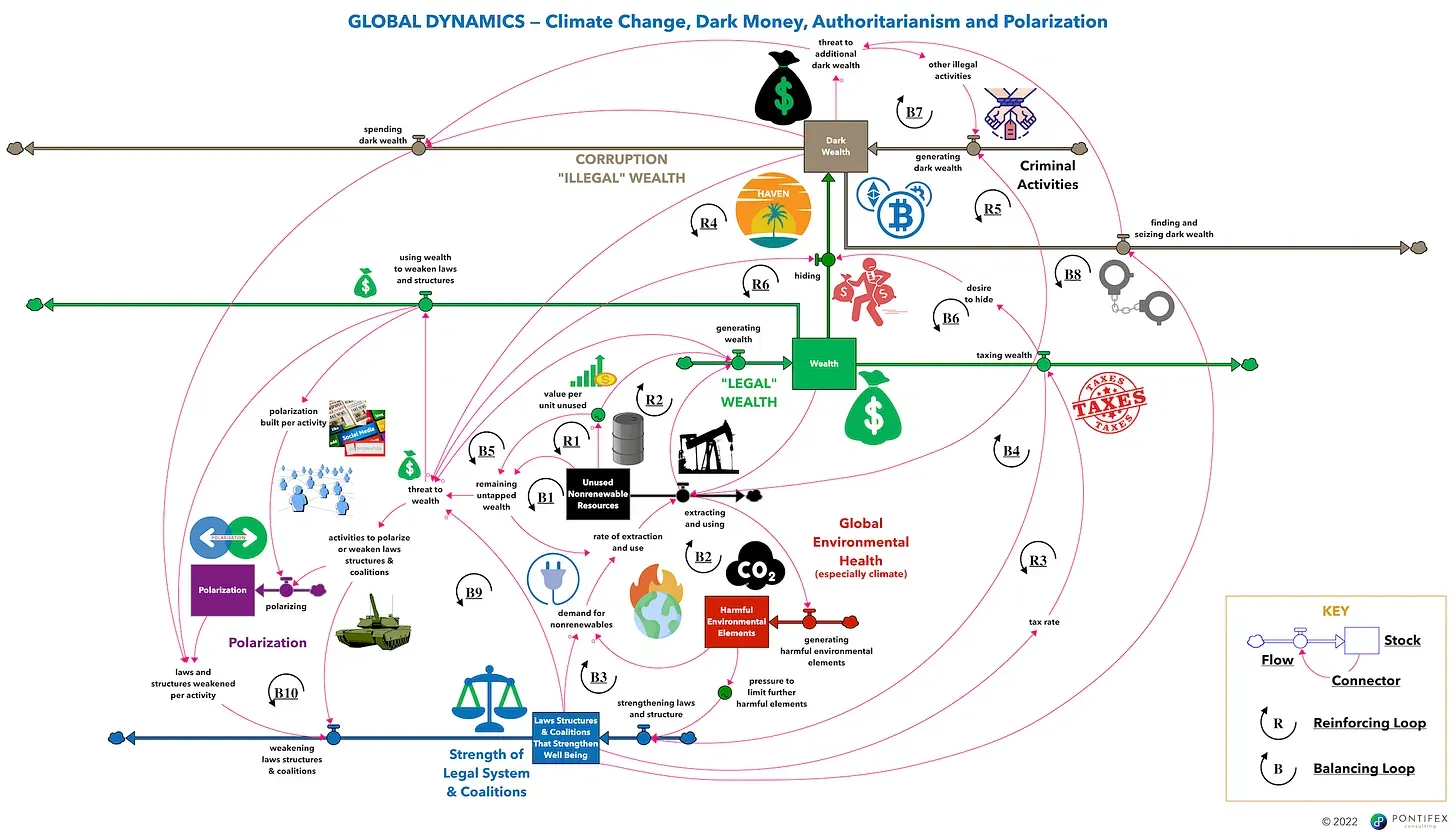
I will create several future posts describing the issues in the global ecosystem map — as individual and interconnected issues — to the Societal Applications section. Understanding these interconnections could help identify the levers needed to avert future crises or mitigate current and future ones.
You can watch the video here.
SUMMARY
As we face increasingly complex global challenges — from climate change to technological disruption — systemic intelligence becomes not just useful, but essential. It provides the cognitive tools we need to navigate uncertainty and work toward more effective, sustainable solutions. Systems Journalism is the vehicle for building our SysQ and insight regarding important global dynamics. We need this insight and capacity to navigate the turbulent waters of today…and tomorrow.
1 Heinberg, R. and Miller, A., Welcome to the Great Unraveling: Navigating the Polycrisis of Environmental and Social Breakdown, Post Carbon Institute, 2023
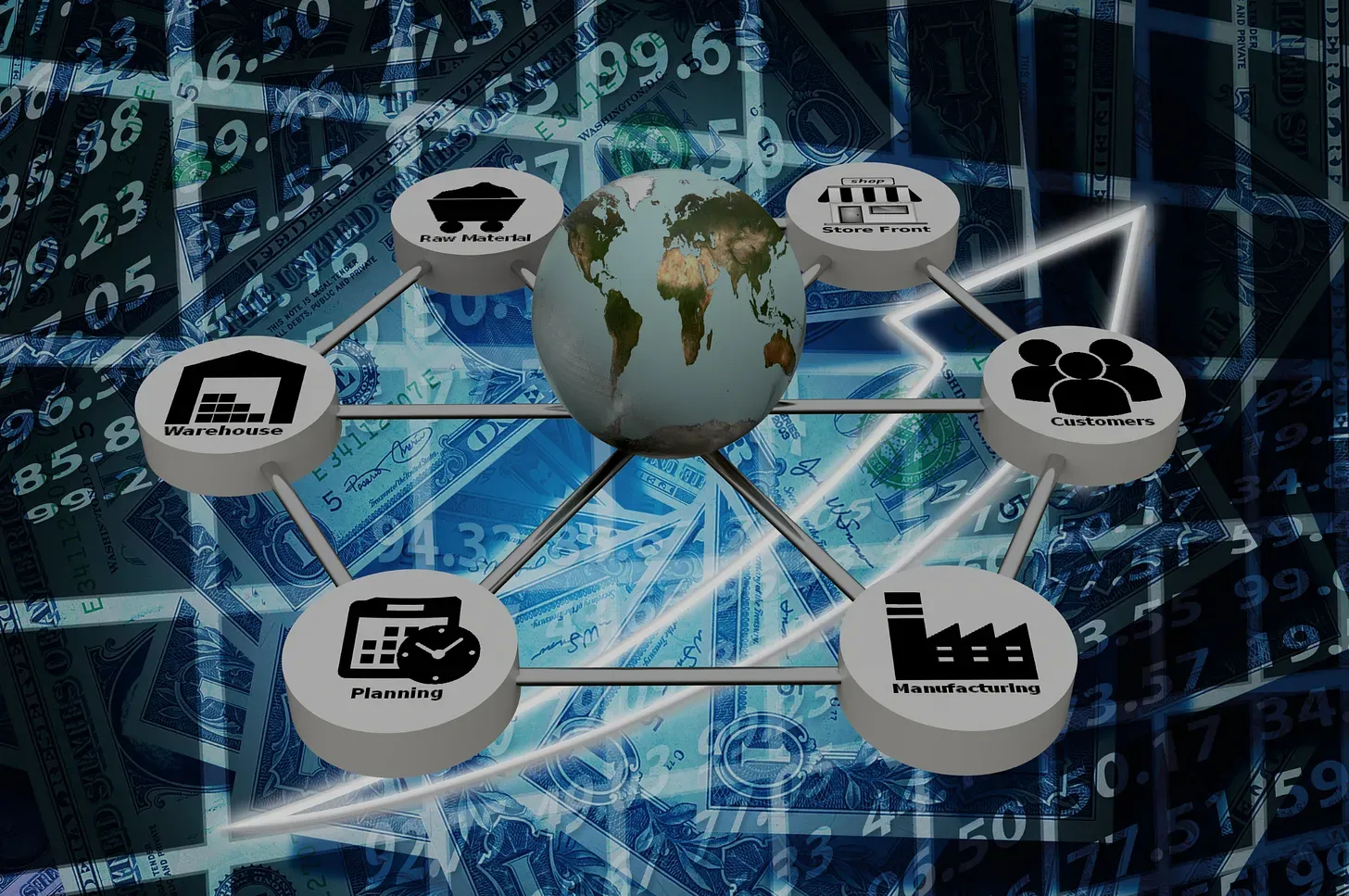
🌐 Inflation Fears Rise. Paper Supply Falls.
Building better understanding of global supply chain woes...and subsequent inflation.
Author’s note (2021)
The following was written prior to news about issues with the transportation system making it harder to get goods across the international economy. These delays only exacerbate the delays in the analysis below, making the impacts of the time delays described here even worse. This is what we’re experiencing.
Author’s note (2025)
Since this article was written, the world experienced long term inflation — as expected. The US managed to bring inflation under control faster. The analysis still holds regarding structural causes of supply / demand imbalances and inflation.
NY Times Headline: The World Is Still Short of Everything. Get Used to It.
US News Headline: Delta, Inflation Fears Push Consumer Sentiment Down Sharply in August
If you tune in to the Sunday morning economic pundits you’ll hear differing opinions about inflation. It’s here. It’s coming. It’s the current President’s fault. No, it’s the previous President’s. What’s going on?
Meanwhile…
A writer friend of mine—excited to be publishing their third book—lamented the other day, “I never thought I’d try to sell a new book in a time when printing paper was hard to find.” You’d think in a digital age there would be plenty of paper. Why the paper shortage? (Just today, Costco announced a purchase limit for toilet paper similar to 2020’s.)
Perhaps most important of all: How might these seemingly disparate issues be related?
SYSQ CAN ILLUMINATE
Systemic Intelligence (SysQTM) is the capacity to frame and analyze issues in ways that can generate maximum insight—which is the only way to identify optimal solutions. One of the core principles of SysQ is to Build a Shared Map of the territory of interest—a picture of the systemic structure driving the system’s performance. Another principle is to Focus on the Physics—make sure the map’s proposed causal connections are consistent with reality.
THE BASICS OF SUPPLY AND PRODUCTION
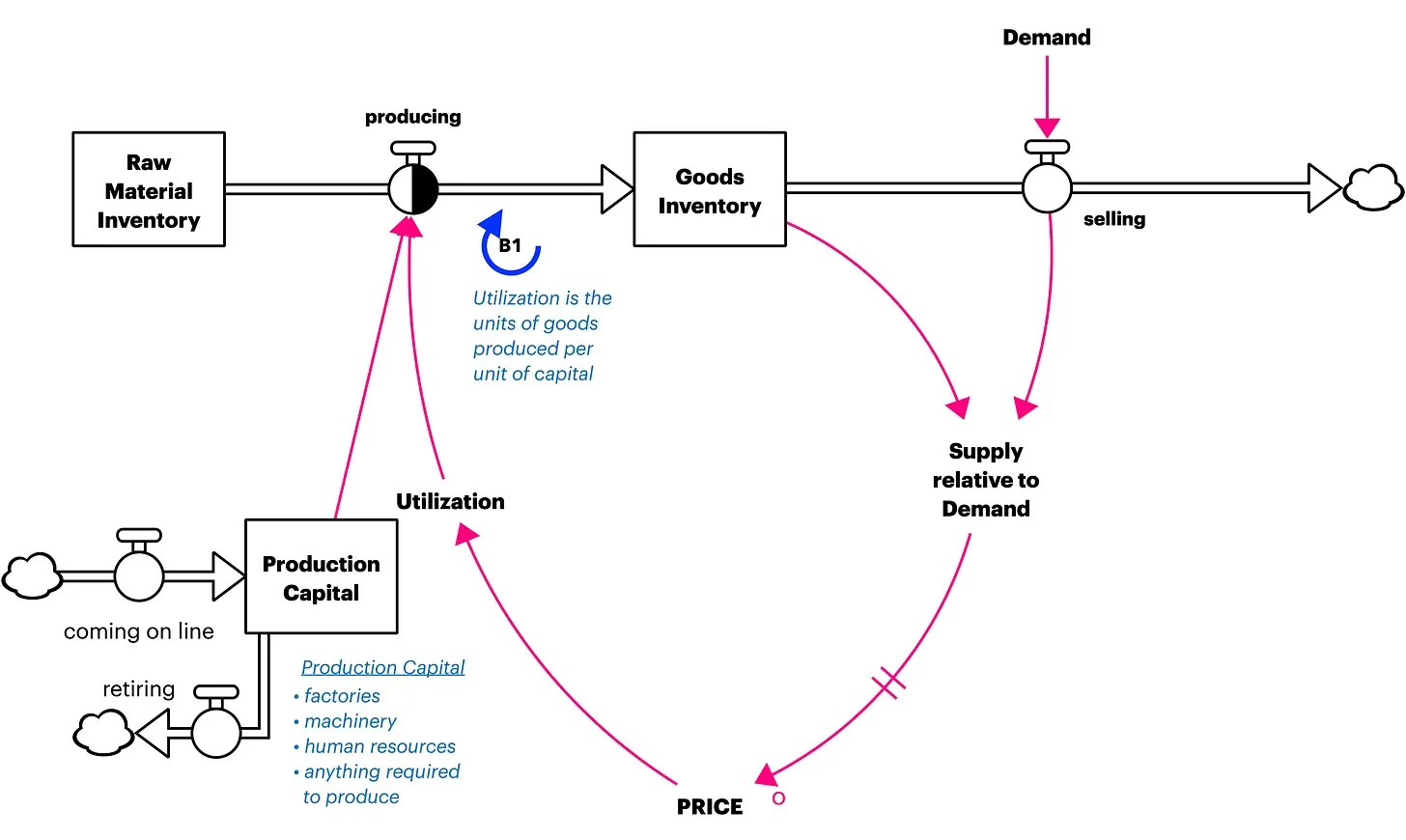
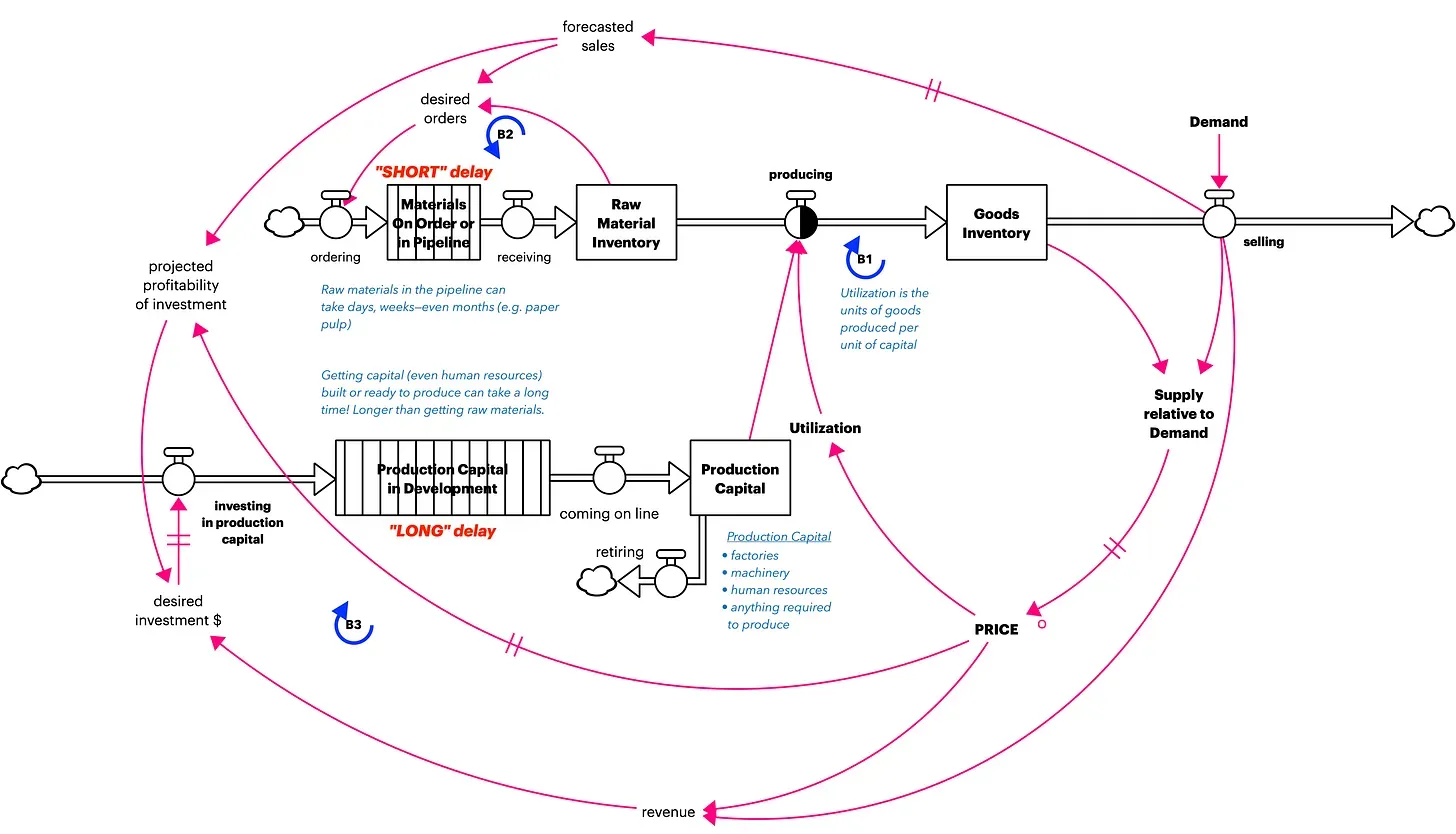
A 30,000 meter view of any industry might look like the map above. At any point in time, you can count up the current amount of goods in the Goods Inventory stock. The stock is like a bathtub. It accumulates inventory.
What fills it up each week is the amount of producing (production) that week. This inflow of producing is like the spigot into a bathtub. The valve (on top) determines how fast or slow the bathtub of Goods Inventory fills. On the outflow, Consumer Demand determines how much selling (inventory sold per week) occurs weekly. If Demand increases, the rate of selling goes up. Lower Demand reduces the rate of selling.
Bathtub physics dictate that Goods Inventory goes up anytime the rate of producing exceeds the rate of selling. The only time Goods Inventory decreases is when selling exceeds producing.
The B1 indicates a balancing loop. Balancing Loops try to maintain equilibrium. If Goods Inventory declines, Price rises, utilization increases, Goods Inventory bounces back…and Price decreases again.
INCREASING THE CAPITAL STOCK INCREASES PRODUCTION
Producing occurs from applying Production Capital. Production Capital is also a stock, because you can stop time and in that moment count up the total amount of capital available. The rate of producing (units of goods produced / week) is determined by Production Capital * utilization (units of goods produced / unit of capital / week). To produce more requires increasing either the amount of Production Capital or its utilization (productivity) of capital—or both.
The binary shading of the producing flow indicates that there’s not a 1:1 conversion of raw material units into units of goods. One computer (a good) requires thousands of parts (raw materials like chips, boards, wires, etc…).
When Goods Inventory is running low, and especially when Price is high and industry profitable, organizations will order more raw materials, increase utilization and/or invest in new capital.
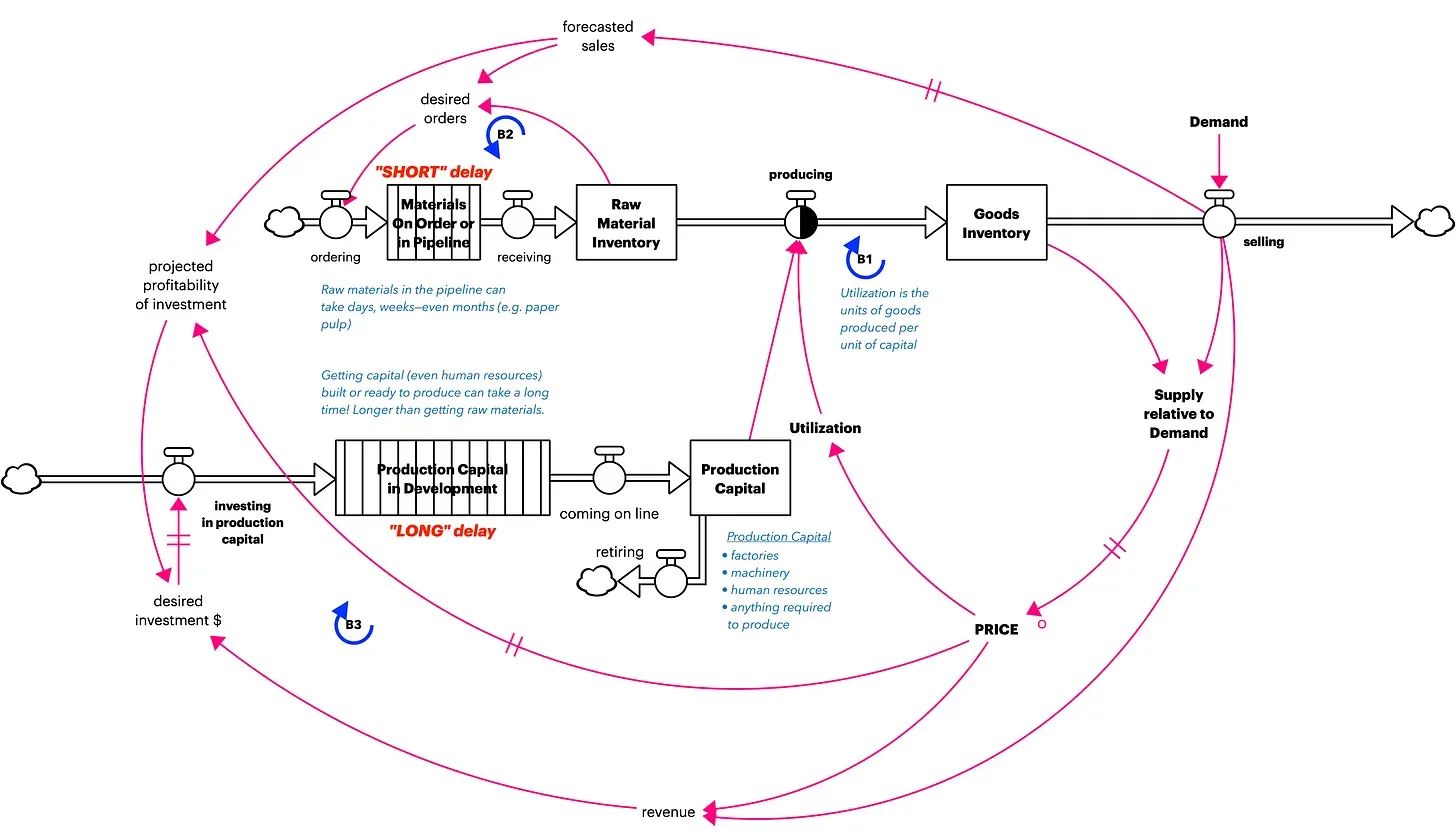
NOTE: It’s often easier—and takes significantly less time—to increase productivity (aka utilization) than to add Production Capital. Adding capital usually requires a flow (activity) of investment in production capital. That capital then steps onto a development conveyor and doesn’t actually become available to produce for a while. Sometimes this time delay takes months.
SUPPLY RELATIVE TO DEMAND—>PRICE
If Demand increases, the rate of selling increases, drawing down Goods Inventory. The Supply relative to Demand falls; Price will increase.
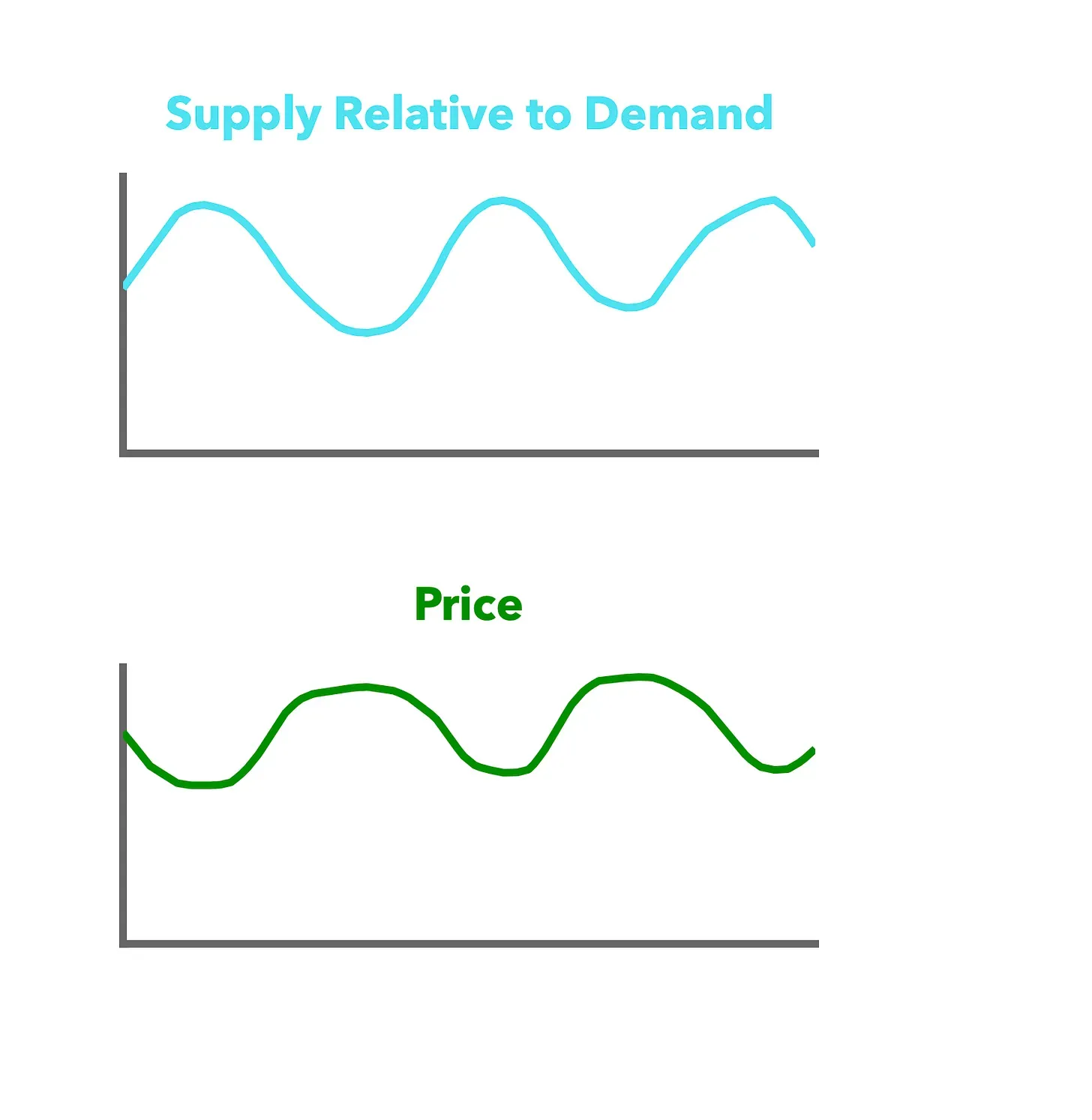
A producer typically responds by increasing utilization (units of goods produced per unit of capital) in order to produce more, filling up Goods Inventory, and bringing supply and demand back into balance. Price usually stabilizes to previous levels. Sometimes, producers will invest in new capital to increase production. This requires a much longer time horizon in order to implement.
**WHY INFLATION? WHY SUPPLY SHORTAGES? AT THE SAME TIME?**
Under most situations, these balancing loops work to regulate the market so that production, inventories, and price oscillates around equilibriums—often with a little annual growth to create an upward sloping curve.
A Sustained Shock
But what happens occasionally are sustained shocks to a system. For example, if there’s a broad and sustained shock to demand (e.g. a lockdown), the following might occur.
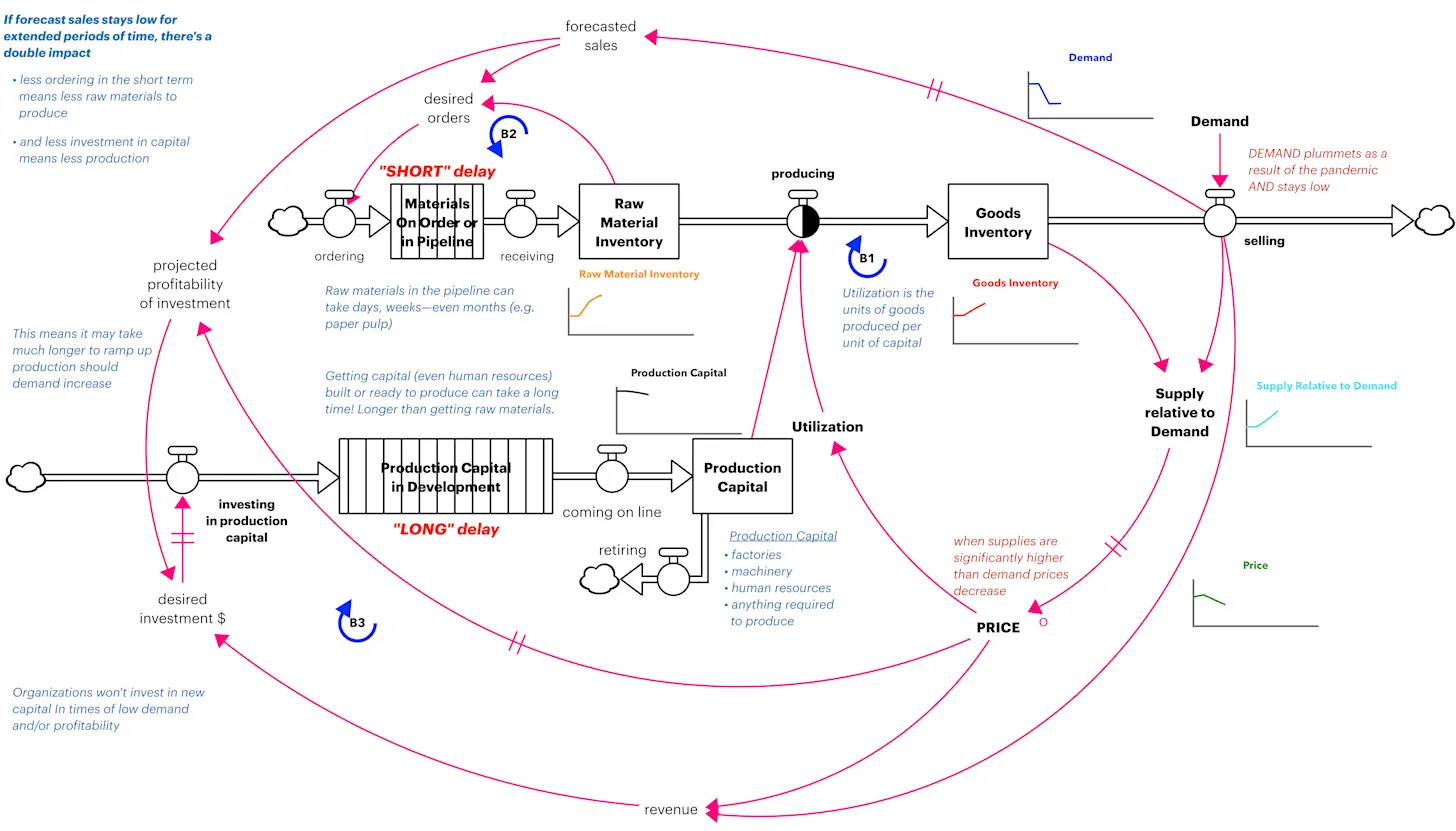
Demand (blue trend) plummets and stays low. Supply relative to Demand begins to creep up (as unsold inventories increase). Too much supply causes Price to drop (or at least not increase anymore).
All of these reduce short-term utilization and materials ordering. This means less harvesting of trees, less of simple materials that are components to chips and computers, less of the basics. There will be less Raw Material Inventory (orange trend)
Further, Production Capital naturally retires, so the stock diminishes (or certainly doesn’t grow).
Demand Returns, But System Remains Behind
If Demand suddenly returns, the system can’t adjust back to normal immediately. Because Goods Inventory is now insufficient for this increased Demand, Supply relative to Demand decreases, and Price increases.
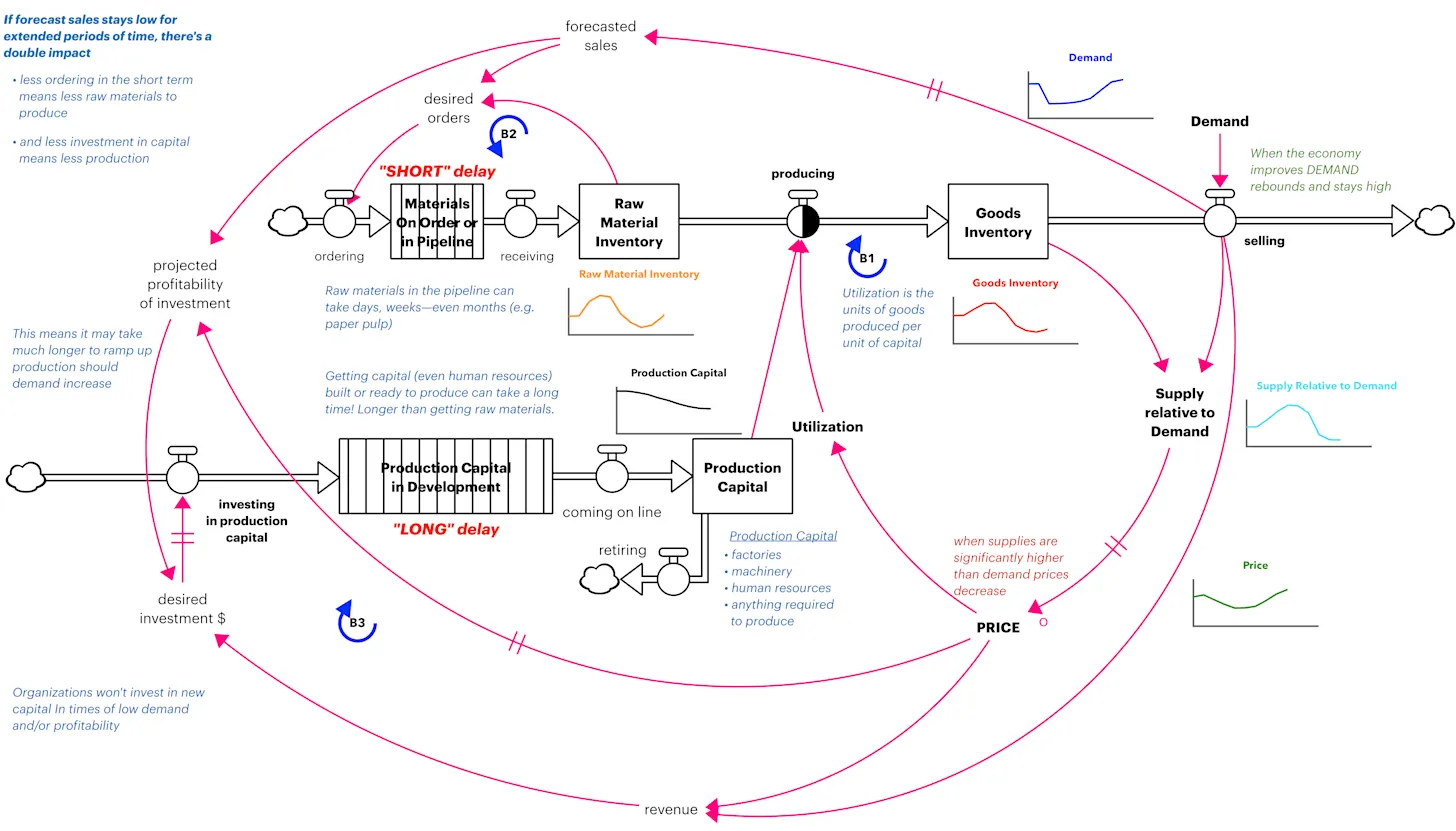
Utilization, ordering, and investing in production capital increases. But due to the long time delays—some delays are substantial—Price continues to rise as Supply relative to Demand remains low.
And INFLATION!
Inflation Continues
Inflation (increasing Price above wage increases) will continue for a long time as the system tries to recover…especially if Demand continues to remain high. The long pipeline delays ensure this dampening of inflation takes time.
Solutions?
What will address this shortage combined with inflation? The main national lever works on demand. The strongest lever is the natural one: Price—>Demand. Yes. Prices will eventually go high enough to naturally suppress demand. As selling slows, inventories can catch up, and Price will fall (or stop rising as fast).
Policies that could slow demand sooner might include short term taxes on some (perhaps luxury) items that require a lot of raw materials. This would increase actual Price faster than inflation and put the brakes faster. Plus, luxury items taxes wouldn’t negatively impact those suffering the most. And if the tax was reinvented in ways that increase the development of supporting infrastructure and capital, then the system would rebound faster.
Additionally, there could be incentives to industries to invest in capital even when their forecasts don’t encourage them to do so. Incentives to add supporting infrastructure or invest in employee development would pay off in the medium to short term.

IMPLICATIONS
What happened in 2020 was unique in that Demand was suppressed suddenly (lockdowns) and for a longer time than typically. This means that rising inflation now is absolutely to be expected. So, who’s to blame?
The current President wasn’t responsible for the 2020 sudden and sustained decrease in Demand. And the previous President, although a different way of handling the pandemic might have reduced the impact on Demand, isn’t responsible for the way the market is now responding to reinvestment to bring production back up to previous levels.
Key Insight
Today’s macroeconomic performance is rarely the result of decisions made within the past few months. Using a longer term mental model of the structure generating performance will increase our ability to assess any attributions of “who’s to blame?”

Testimonials
Clients