 SysQ Mindset
mindset
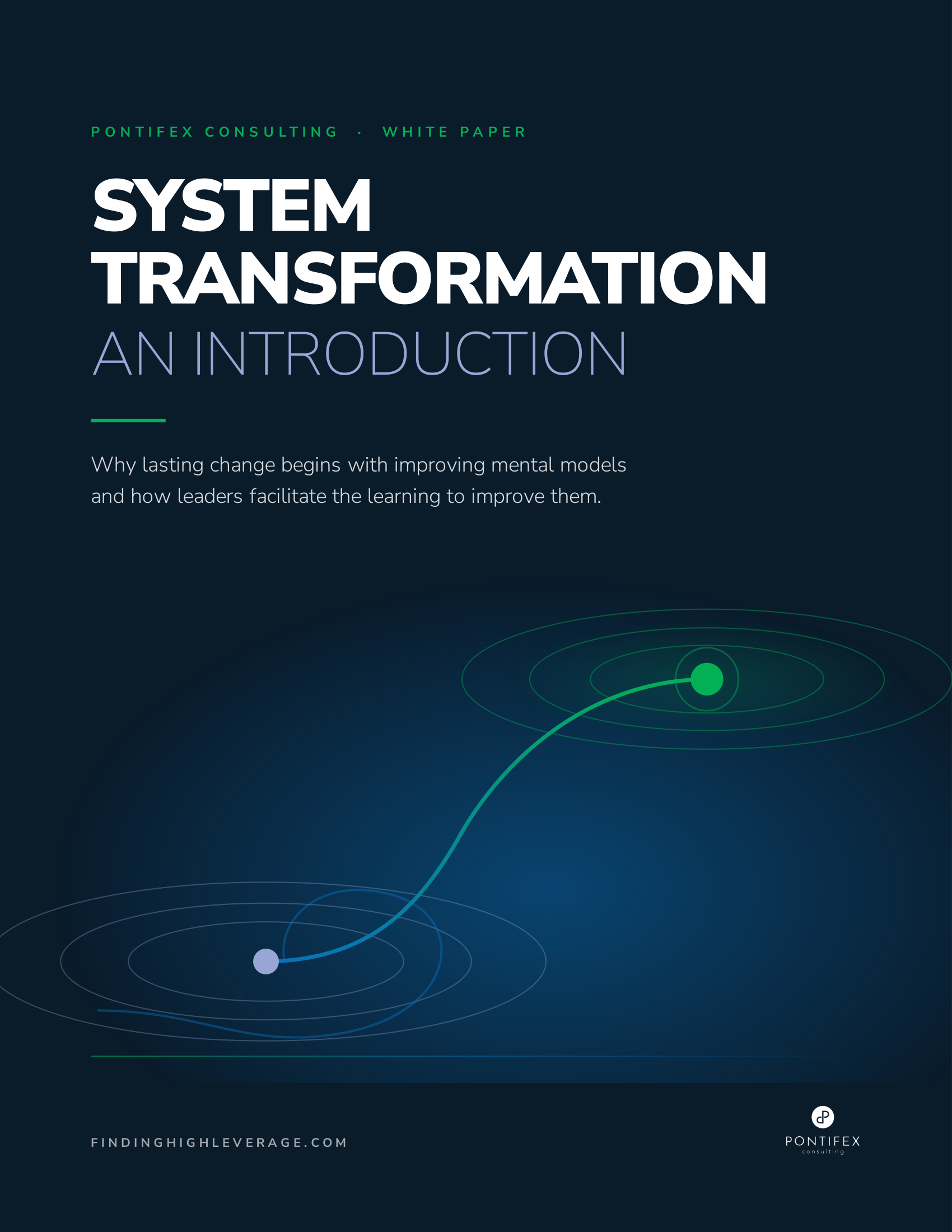
System Transformation
MINDSET
Why lasting change begins with improving mental models, and how leaders facilitate the learning to improve them.
WHITE PAPER
In the spring of 2002, the Oakland Athletics walked into a season they had no business winning. The previous October, after winning 102 games and pushing the New York Yankees to a fifth and decisive playoff game, Oakland watched three of its best players walk out the door. Jason Giambi, the reigning American League MVP, signed with the Yankees. Johnny Damon, the leadoff hitter, signed with the Red Sox. Jason Isringhausen, the closer, signed with the Cardinals. The reason was money. Oakland's payroll for the coming year would be roughly $40 million. The team they were chasing would spend more than $125 million. By the standards of the sport, the math was finished. Owners counseled patience. Sportswriters told their readers Oakland was rebuilding.
They should resign themselves to a losing season. And then it didn't happen.
That summer the Athletics won 103 games. They won twenty in a row, the longest winning streak in the history of the American League. They went back to the playoffs. They did it spending less than a third of what their rival spent.
What Billy Beane and his assistant Paul DePodesta had done was abandon the mental model the sport had used to judge players for more than a century. For a hundred years a player's value had lived in the heads of professional scouts: the look of him in a uniform, the smoothness of his swing, the famous "good face." Bill James had spent twenty-five years showing, with patient arithmetic, that the most valuable thing a hitter can do is simply not make an out. Baseball ignored him. The men who ran the game already knew what a ballplayer looked like.
Within a few years Boston had hired Bill James and won its first World Series in eighty-six years. Within a decade every front office in the sport had been remade in Oakland's image. The system the A's had been competing inside of in 2001, the one in which a $40 million franchise cannot beat a $125 million franchise, was no longer the system anyone was playing in. A different game had begun.
Systems don't slide. They jump.
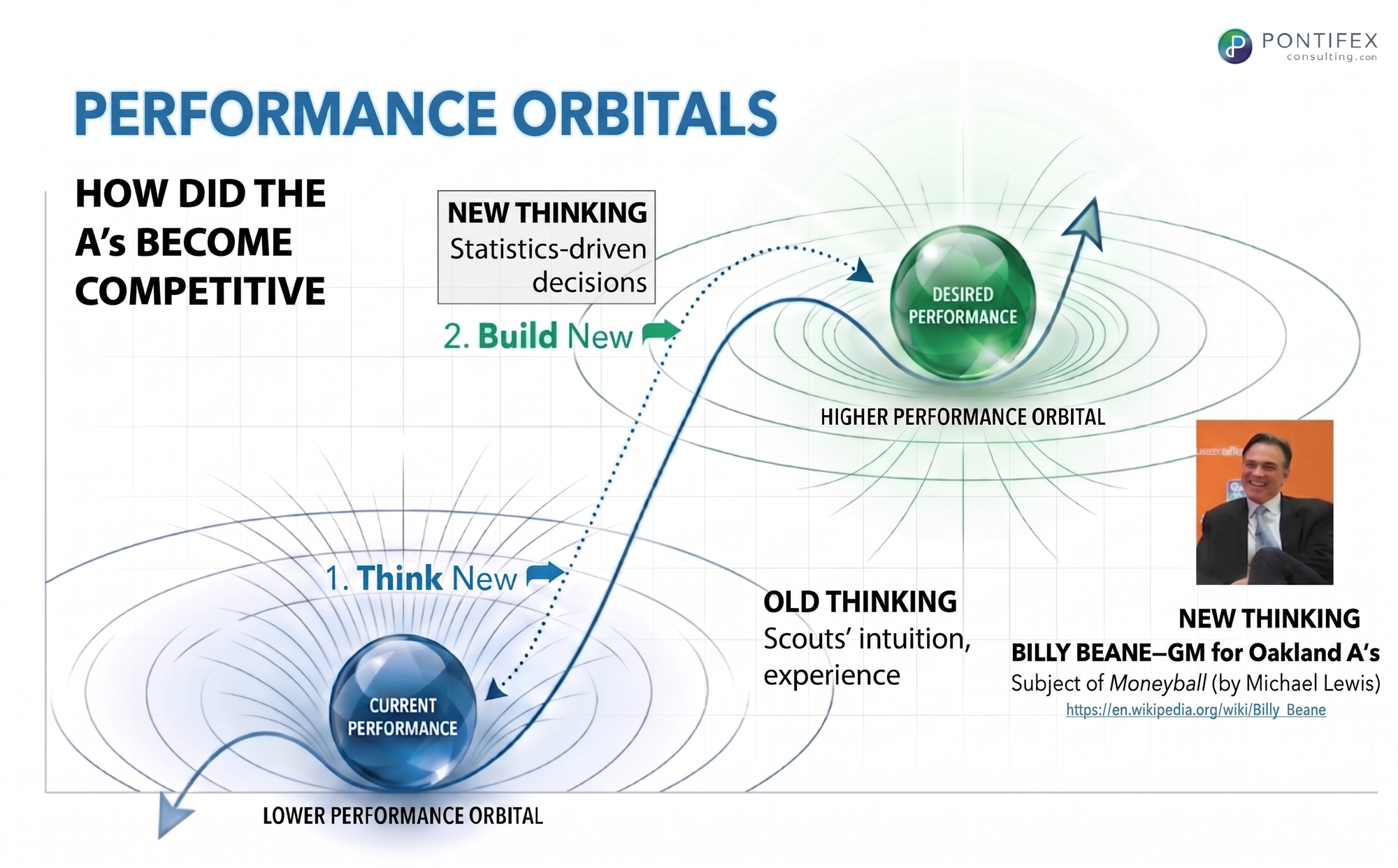
Barry Richmond, who taught at Dartmouth and later founded isee systems, had a particular way of describing system performance, and he took it from physics rather than from management. Systems do not perform on a smooth gradient. They perform in orbitals: stable bands of behavior held in place by the forces that shape them. A system fluctuates inside its orbital, and it does not drift out of one without something significant changing.
Organizations behave this way. So do agencies, coalitions, school districts, and entire fields of practice. Whatever else these systems differ on, they share the physics.
A lower orbital is not a sign that nobody is trying. The 2001 Athletics were trying extremely hard. Portugal, facing a heroin crisis that had reached nearly one percent of its population, was trying hard too, applying enforcement and prosecution and imprisonment year after year while the numbers got worse. So is every agency, district, and coalition currently stuck in the orbital it wants to leave. A lower orbital means the structure is producing the result it was built to produce. Another quarter of incremental effort, another round of best practices, another well-intentioned initiative: these add energy, but rarely the right kind, and rarely enough. The system absorbs the bump and settles back where it was.
What actually holds an orbital in place
The temptation is to answer that question with a list of factors. Politics. Budgets. Culture. Inertia. Resist the list, and ask instead how the thing actually works.
The visible answer is structure: rules, policies, budgets, org charts, procurement procedures, performance metrics, funding cycles. That machinery is real, and it is not the deepest cause. Beneath it sits the shared mental model the structure expresses. It is the collective answer to "what work are we actually here to do?", "what do the people we serve actually need?", "what counts as quality?", "who gets to decide?" Those answers are usually unspoken and almost never examined. They are also usually correct enough to have produced the success the system once enjoyed. That is what makes them so hard to see, and so hard to change.
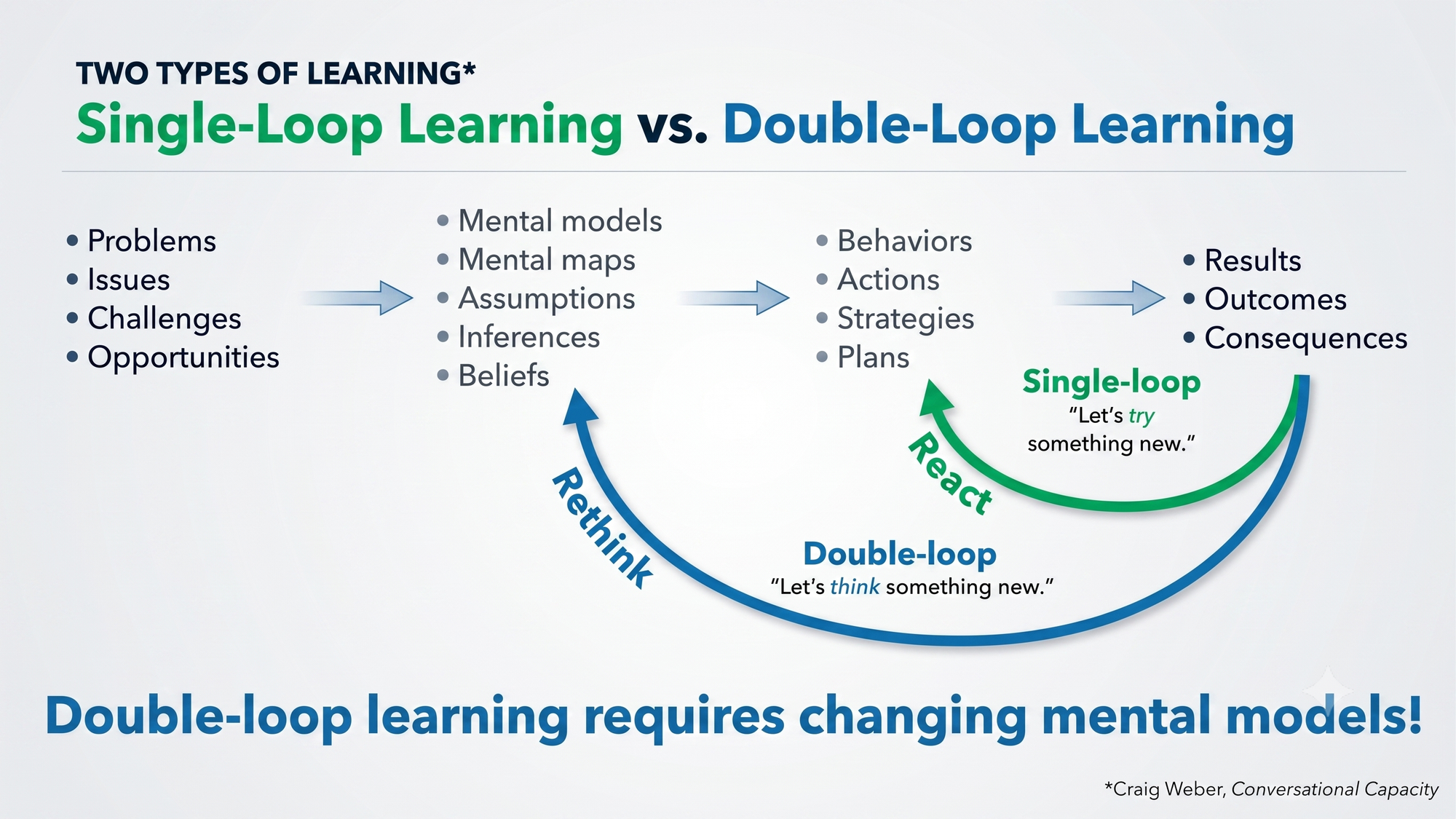
Chris Argyris gave the two kinds of learning their names. Single-loop learning corrects the action: something goes wrong, you adjust, you patch the procedure, you try harder. A thermostat learns this way, and never once asks whether 68 degrees is the right temperature. Double-loop learning reaches past the action to the model producing it.
That is what Beane did in Oakland. It is what Portugal's national commission did in Lisbon in 1998, when it concluded that the country's failure ran deeper than bad enforcement. The model underneath the laws was wrong: addiction as crime, users as criminals, punishment as cure. Portugal reclassified personal possession as a public health matter in 2001 and moved the money from prosecution into treatment. Over the following decade, HIV infections among drug users fell by more than 95 percent, and the share of the prison population serving time for drug offenses fell from 44 percent to 24 percent. No new medicine was invented. What changed was the set of assumptions governing how the problem was defined and who owned it.
Double-loop learning is uncomfortable work. It exposes the possibility that people who spent careers mastering the existing model have been mastering the wrong thing. It is also the only kind of learning that has ever moved a system from one orbital to another.
Why so many transformations don't take
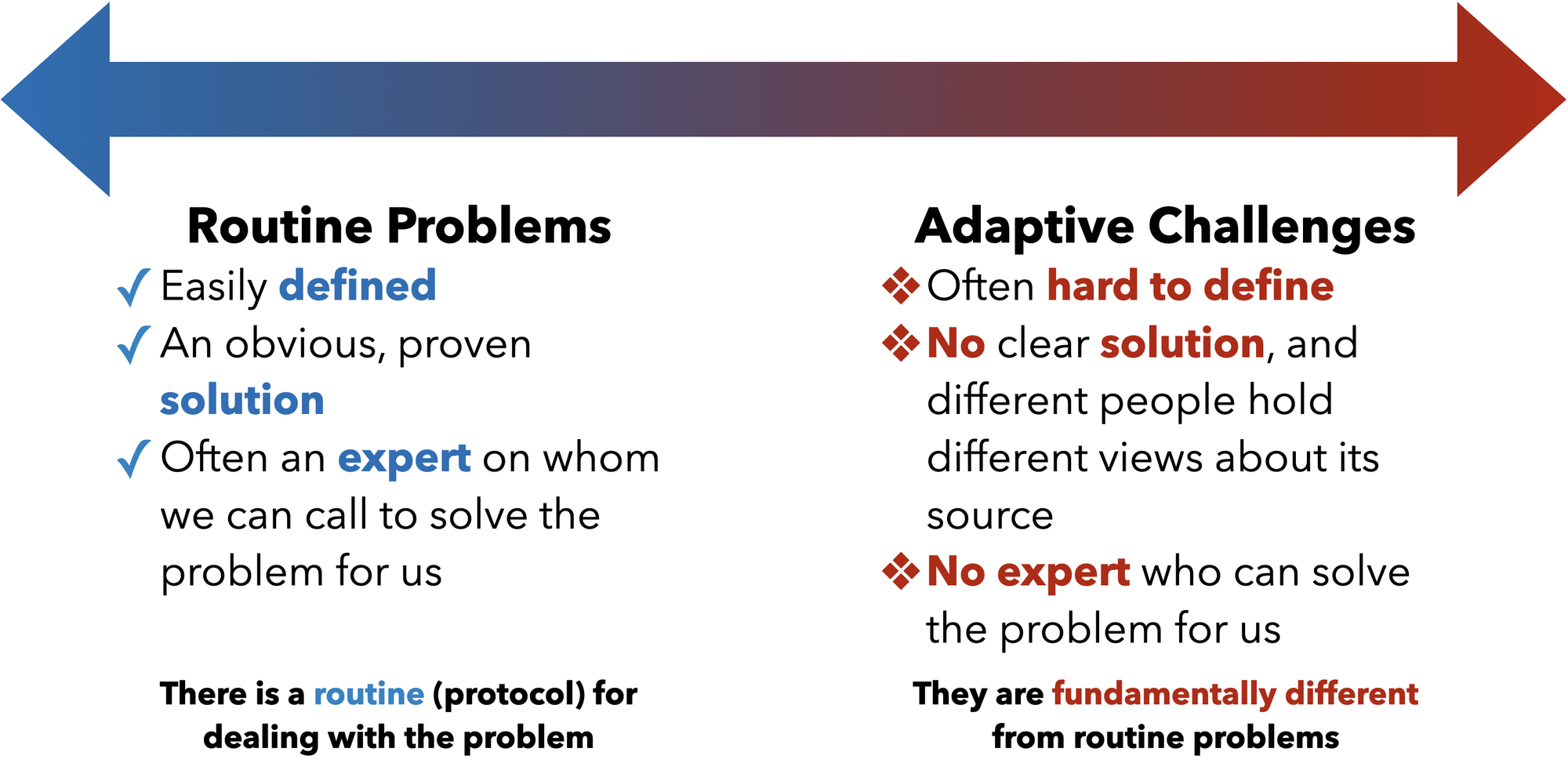
Most of them were attempted as routine work. Ronald Heifetz's distinction is the one to keep. A routine problem is one where the know-how exists, the authority to act is clear, and the path from problem to solution can be drawn in advance. Routine problems can be enormously complex. Landing an aircraft. Performing surgery. Running a national election. Their complexity is the kind that yields to expertise.
An adaptive challenge is different in kind. Nobody yet knows what the path is, and solving it requires people to change their values, habits, loyalties, and ways of working. The expertise that produced past success may actively obstruct future success. Beane's challenge in 2002 was adaptive. The routine version of it ("assemble a roster on $40 million") had a known answer that everyone in the league understood, and that answer was: lose.
When an adaptive challenge gets handled as a routine one, the pattern is familiar. New software gets installed. New procedures get documented. A strategic plan circulates, committees get renamed, the org chart gets redrawn. The mental models don't shift, the loyalties don't move, and eighteen months later the system is producing what it produced before. The diagnosis afterward is almost always some version of "we tried, it didn't take." The work was misdiagnosed at the start.
What's in the paper
System Transformation: An Introduction is the opening chapter of the System Transformation Guide, and it makes this case at full length: Oakland and Portugal in detail, the Bureau of Engraving and Printing holding on to steel-plate engraving while the world switched to peel-and-stick, Xerox inventing the personal computer and failing to recognize it as something Xerox would ever sell, and Laurence Gonzales's mountain climbers, who die on familiar mountains because they expect conditions to match their last successful ascent. It takes up Jennifer Pahlka's Three Horizons distinction between reform that builds the next system and reform that quietly extends the life of the failing one. And it lays out the Five Phases the guide is organized around:
- Frame the Right Problem: separating adaptive challenges from routine ones, and drawing the trend you're trying to bend before anyone argues about strategy.
- Work Across Boundaries: who actually has to be in the room, and the conversational capacity to keep them there.
- Improve Mental Models: surfacing assumptions, recognizing the archetypes that make well-intentioned interventions backfire, and building a shared causal picture a group can argue with.
- Apply Action Learning: turning that picture into a testable hypothesis, so you find out early whether reality agrees.
- Build Adaptive Leadership Capacity: the phase most guides skip, and the one that decides whether any of this outlives you.
The paper is free, it runs about 30 pages, and you can read it in an evening.
Then come work it with other practitioners
Reading the argument is the easy part. The hard part arrives on a Tuesday morning, when you're standing in front of fourteen people who report to different bosses, hold different theories of the problem, and have already survived two failed transformations. Somebody has to ask the question that surfaces the assumption nobody has said out loud. Somebody has to keep the room in the inquiry at the exact moment it wants to bolt for a decision. That somebody is you, and no argument, however well made, tells you what to say at 9:15.
We acquire the skills to lead transformation by doing the work on problems we care about, often poorly at first, with somebody to compare notes with. Pilots don't learn to fly by studying aerodynamics. They log hours.
The Orbital Shift Lab is where those hours get logged. It's the practitioner community for consultants, facilitators, OD professionals, and internal change agents who run these sessions for a living or are moving toward it. Members bring a real challenge, get help framing it, come back with what happened, and find out how somebody in a county health department solved a problem that looks nothing like theirs and turns out to be the same problem underneath. Every member gets a starter set of facilitation exercises free, so you can run one with a real group before you pay for anything. Subscribing members get the complete guide, every exercise deck in both self-guided and facilitated modes, the full facilitation layer, live practice sessions, and direct access to me.
If you'd like to learn more about how to guide system transformation...
Join Us
Our mental models set our performance orbital. They do more than hold our systems in place. They hold us in place. So the work begins there, and it begins better in company than alone.
If your work sits in public health, climate, education, democracy, or humanitarian response rather than in consulting or OD, the sister community is The Flourishing Constellation at flourishingconstellation.com. Joining is free, and so is the starter set of exercises.
If you'd like to learn more about how to support system transformation across society as we navigate a range of interconnected, systemic issues...

Mind
Breaking Free From the Hamster Wheel: The Power of Double-Loop Learning
MINDSET
Attribute of Mindset
To create new, we must think new
About
Double-loop learning, introduced by Chris Argyris in the 1970s, goes beyond single-loop learning—where errors are fixed without questioning underlying rules. Double-loop learning occurs when we challenge and modify the core assumptions, goals, and mental models driving decisions. This deeper process enables individuals and organizations to adapt more effectively to complex challenges, supporting innovation through reflective shifts in governing values rather than mere tactical adjustments.
“The illiterate of the twenty-first century will not be those who cannot read and write, but those who cannot learn, unlearn, and relearn.” — Alvin Toffler The Problem with Our Mental Models
Have you ever felt like your organization is running faster and faster just to stay in the same place? Like Alice in Wonderland, many leaders find themselves stuck in what I call the "organizational hamster wheel" - expending enormous energy without making real progress. The root cause often lies in our mental models - the stories and assumptions we use to make sense of the world.
The Limits of Single-Loop Learning
Most organizations default to what Chris Argyris calls single-loop learning - we observe an outcome we don't like, make an adjustment based on our existing mental models, and hope for better results. Consider these cautionary examples:
- Wells Fargo tried to improve performance by incentivizing employees to open more accounts. This led to widespread fraud as employees opened accounts without customer knowledge.
- Humanitarian organizations attempted to combat malnutrition in Peru by providing food directly to families. They didn't anticipate that families would give the food primarily to working males, leaving children still malnourished.
- A claims processing department faced high workload and responded by aggressive hiring. This actually worsened their problems as training demands increased stress on experienced staff, leading to more turnover.
In each case, organizations applied solutions that made intuitive sense based on their existing mental models. But those models were fatally flawed.
The Anatomy of Problem-Solving
To understand why organizations fall into these traps, let's examine the three distinct phases of problem-solving.
Phase 1: Sense-making
We begin by identifying a gap between our current reality and our vision of an ideal future state. Think of it as the difference between "what is" and "what could be." This gap forms the frame of our problem. We then access our mental models - our theories about how the world works - to make sense of this gap and its causes.
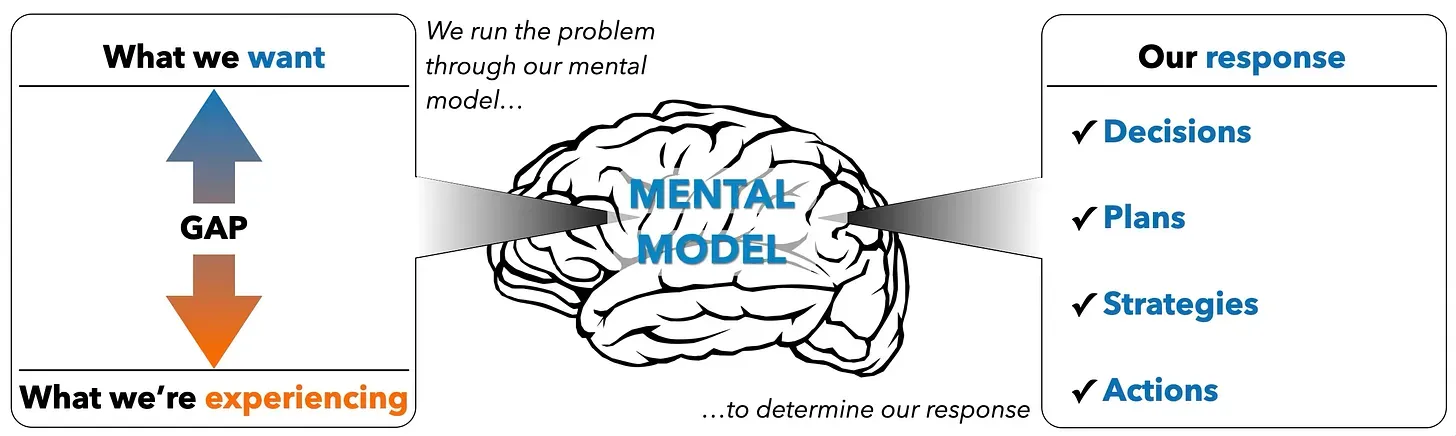
Phase 2: Solving
Using these mental models as our guide, we develop solutions. Like a receipt printing from a checkout machine, our mental models process the problem and output what we believe to be the best plan or strategy. While this might seem oversimplified, it evocatively represents how we move from understanding to strategy and decisions.
Phase 3: Implementing and Learning
Finally, we put our solution into action and observe the results. Sometimes everything works as planned. But often, we face unexpected outcomes or find the gap persists. At this critical juncture, we face a choice: do we just adjust our solution, or do we question our underlying assumptions?
This is where many organizations get stuck. When faced with disappointing results, the natural tendency is to loop back to Phase 2 - tweaking the solution while using the same mental model.
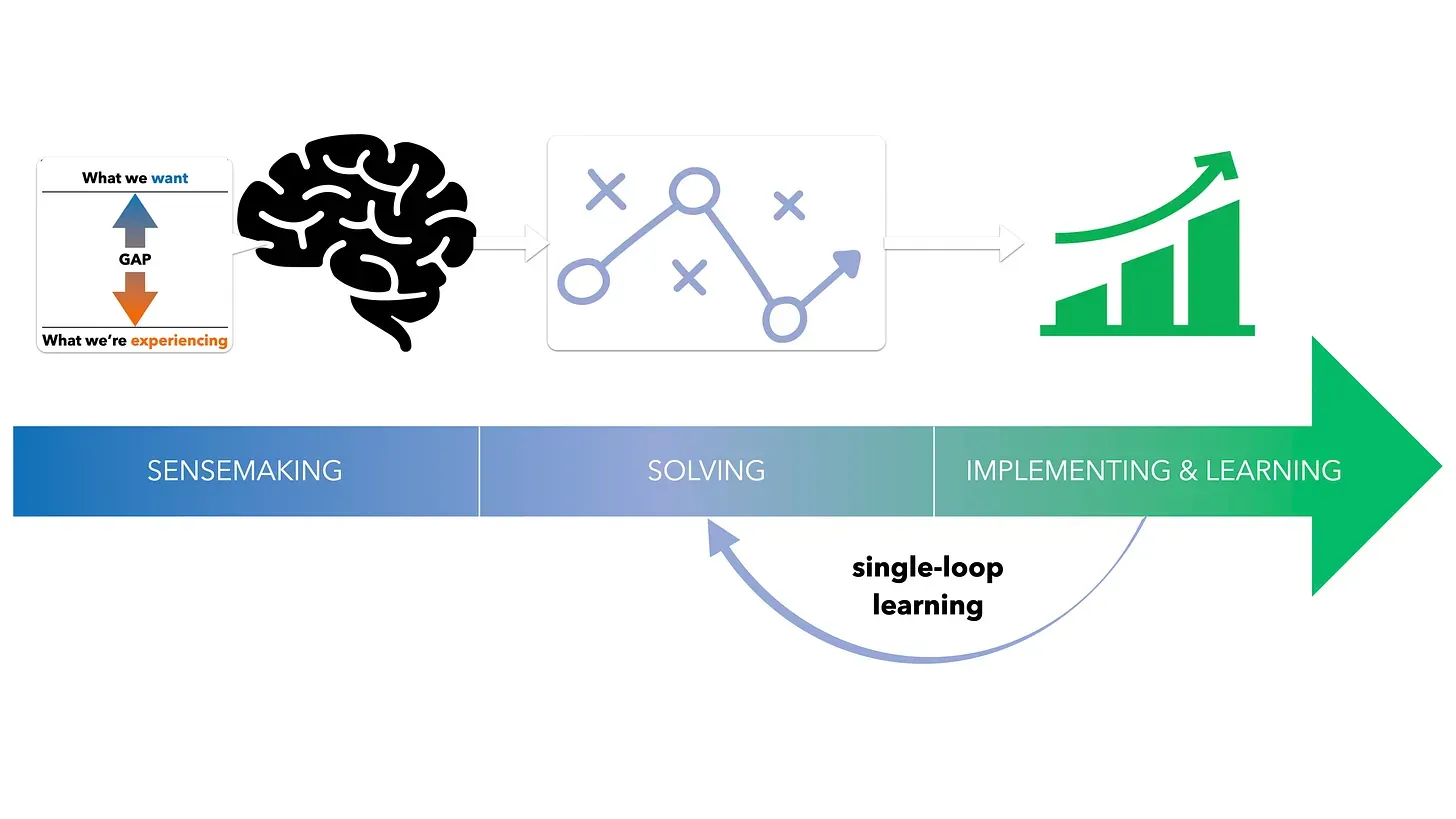
Remember our claims processing department? When their initial hiring push didn't solve the problem, they simply decided to hire even more people, faster. This is classic single-loop learning - adjusting the solution without questioning the underlying assumptions that created the problem in the first place.
Understanding Double-Loop Learning
This is where double-loop learning is required. Instead of just adjusting our actions (the single loop), we examine and revise our fundamental assumptions about the problem (the second loop). We surface, explore, test, and improve our mental models.
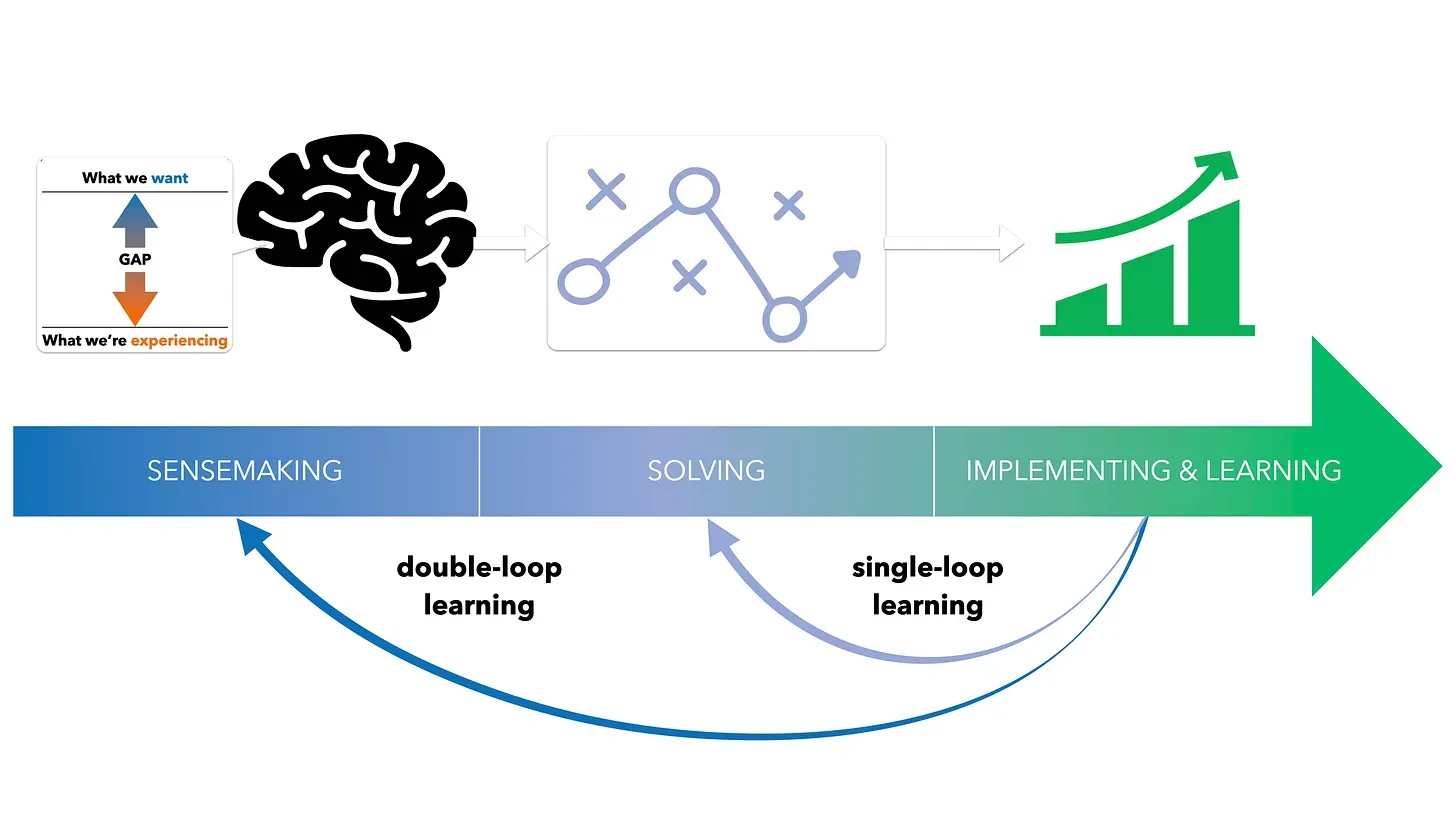
The process works like this:
- We identify a performance gap between our aspirations and reality
- Instead of jumping to solutions, we pause to examine our mental models
- We use tools like systems mapping to make our assumptions explicit
- We test and revise those assumptions based on evidence We develop new mental models that better reflect reality
- Only then do we design solutions based on these improved models
Moneyball: The Power of Double-Loop Learning
One of the clearest examples comes from baseball. Billy Beane and the Oakland A's revolutionized how baseball teams evaluate talent by questioning fundamental assumptions about what makes a valuable player. The conventional mental model focused on batting average and RBIs. By examining and revising these mental models, they discovered that on-base percentage and slugging percentage were better predictors of offensive success.
This wasn't just about trying a different metric - it was about fundamentally reconceptualizing how baseball talent evaluation worked. The results transformed the sport.
Building Better Mental Models Through Systems Thinking
Effective double-loop learning requires what's called "systemic intelligence" or SysQ - the ability to see and understand the driving characteristics of complex systems. This involves:
- Making mental models explicit through visualization tools
- Understanding how different parts of the system interact
- Identifying high-leverage intervention points
- Testing assumptions through careful observation Learning continuously during implementation
Billy Beane — and his management staff — double-looped their mental models of what makes great baseball players. The claims department mentioned earlier eventually double-looped and stopped hiring to address staff shortage. And organizations working to address malnutrition in Perú also created a double-looped, collective mental model of why malnutrition persisted…and how to reduce it.
Moving from Theory to Practice
To apply double-loop learning in your organization, team, or coalition:
- When facing persistent problems, pause to examine your mental models — step off the hamster wheel!
- Where possible, use tools like system mapping to make assumptions explicit
- Apply Conversational Capacity to engage multiple perspectives — challenge your mental models
- Test revised models with small experiments — use maps or simulation models if possible
- Create learning loops to enable continuous learning — leading indicators are especially valuable
Remember: the goal isn't just to solve today's problem, but to transform our understanding in ways that help us handle future challenges better. That's how organizations break free from the hamster wheel and achieve sustainable success.
Double-Loop Learning in Action: Two Success Stories
Transforming Huntsville into a Tech Hub
Huntsville, Alabama faced a critical challenge: despite attracting young tech talent for internships and entry-level positions, they couldn't retain them. The city's initial mental model assumed this was primarily a compensation issue. However, through a rigorous ecosystem mapping process, they discovered something surprising: their strategy of importing seasoned STEM professionals was actually undermining their ability to retain young talent.
The mapping process revealed that young professionals weren't leaving primarily because of money - they were leaving because they were bored. This insight led to a fundamental shift in their mental model about what makes a city attractive to tech talent. Instead of just focusing on traditional economic development, they realized they needed to invest in what they called the "soft stuff":
- Creating vibrant arts and culture scenes
- Developing outdoor shopping areas with restaurants
- Establishing entertainment venues like minor league baseball Building community gathering spaces
By questioning and revising their mental models about talent retention, Huntsville transformed itself into one of America's most attractive tech communities. This wasn't just a change in tactics - it represented a fundamental shift in how they thought about economic development.
Reimagining Claims Processing
A Fortune 100 financial services company provides another powerful example of double-loop learning. Their claims department faced a perfect storm: high turnover, increasing workload, stressed employees, and declining customer satisfaction. Their initial mental model suggested a straightforward solution: hire more people faster.
However, through a series of facilitated mapping sessions, they discovered that their assumptions about the problem were fundamentally flawed. The mapping process revealed:
- Faster hiring actually increased stress on experienced staff
- Training burdens were overwhelming mentors
- Emotional intelligence was more critical than technical skills
- Staff well-being directly impacted customer satisfaction
This new understanding led them to completely reimagine their approach. Instead of just accelerating hiring, they:
- Developed emotional intelligence training programs
- Created formal mentoring structures with manageable ratios
- Implemented stress management initiatives
- Built workload management systems that balanced efficiency with employee wellbeing
The results were transformative: higher employee satisfaction, lower turnover, and better customer outcomes. But perhaps most importantly, they developed a new mental model about the relationship between employee development, workplace stress, and organizational performance.
The Learning Organization: Moving Beyond the Hamster Wheel
These success stories illustrate a crucial point: double-loop learning isn't just about solving problems - it's about transforming how organizations think about their challenges. In both cases, success came not from trying harder within existing mental models, but from fundamentally reconceptualizing the nature of their challenges. By seeing deeper…with greater rigor and clarity.
The ultimate benefit extends beyond solving individual problems. It creates what Peter Senge calls a "learning organization" - one that's constantly examining and improving its mental models and growing its systemic intelligence (SysQ).
In today's complex world, this capacity for deep learning might be the most important competitive advantage an organization can develop. Are you ready to question your mental models and engage in double-loop learning?
Additional Resources
Books
Book title as link | Description
Articles
Article title as link | Description
Online Resources
Resource title as link | Description

Mind
Purpose? Seeing Structural Forces Generating Performance...and Finding Leverage
MINDSET
Attribute of Mindset
See the structure, find the leverage, transform the outcome
About
We've all experienced it: problems that refuse to budge no matter how hard we push, strategies that fail to deliver lasting change. We fixate on symptoms and external forces while the real culprit hides in plain sight. This foundational principle of Systemic Intelligence reveals why most interventions fail and points to where genuine leverage actually lives. When you understand that structure drives behavior, you stop wasting energy on futile fixes — and start finding the transformation points that actually work.
“The important thing in science is not so much to obtain new facts as to discover new ways of thinking about them.” —Sir William Bragg
The slinky principle: Transforming how we see and solve problems.
In today's rapidly evolving world, we face increasingly complex challenges - from organizational transformation to climate change, from healthcare reform to technological disruption. Yet our approach to solving these challenges often resembles watching a magic show: we see the effects but struggle to understand the underlying causes. We react to symptoms, implement quick fixes, and wonder why our solutions don't stick. There's a better way.
Systemic Intelligence (SysQ) offers a powerful lens for seeing and solving complex problems. Like a skilled magician who understands the mechanics behind illusions, those with high SysQ can peer beneath surface-level events to grasp the deeper structures driving behavior. This capability isn't just academic - it's the key to finding genuine leverage points for lasting change. Whether you're a business leader navigating market disruption, a policymaker addressing societal challenges, or an individual trying to create sustainable change, understanding the "magic" behind system behavior is your pathway to more effective action.
SysQ’s magic helps you find leverage — the ability to fundamentally transform the system you wish to improve. This requires understanding the mindset — or as I often think of it, the purpose or aim of systemic intelligence. The aim of SysQ is summarized in a a core tenet that is the magic phrase you’ll need to find the leverage you want.
To Find Leverage You Must First Understand the Structure Driving Behavior
EXAMPLE — SYSTEM 1
I’m going to administer an input to this system.
Answer the following question with the first idea coming to mind.
So gravity and removing the hand are necessary but insufficient to create the oscillating behavior.
What’s the cause of this behavior?
One important attribute of leverage is the ability to fundamentally improve ecosystem performance. Imagine that you want to significantly improve the oscillations — to dramatically dampen them — perhaps they are creating chaos in your organization.
If your mental model is that gravity is causing the oscillation, how much leverage do you have? None. You can’t change gravity. I imagine you can identify times in your work and personal lives where it feels like fighting gravity — something refuses to improve no matter hard you try.
If your mental model is that removing the hand is causing the oscillation, how much leverage do you have? Before you say some, let’s also say you don’t own the hand. Again you have no leverage. You can either become an Eeyore and proclaim nothing will change. Or you’ll be a victim and blame others. Either way, you’re stuck with a persisting problem.
However, if your mental model is that the system generates the behavior, you can modify the system so that when the hand is removed by someone else — and even though gravity exists — the behavior is fundamentally improved. You’ve found leverage.
Ascribing the cause of the behavior to the system — the structure of the slinky — leads to solutions that...
Watch this cotton candy eating contest.1
Whose mental model is the high-leverage one?
FOCUS ONLY ON THE STRUCTURE GENERATING PERFORMANCE
We often respond to problems using the same old thinking — applying outdated and inaccurate mental models — without once questioning: Do I know the structure of this ecosystem that’s responsible for this problem?
If we don’t develop sufficient systemic insight into how the ecosystem works we will be unable to achieve the performance goals we set. We will continue to be buffeted by the “slings and arrows of outrageous fortune”. The Focus is Only on the Structure Generating Performance
Disciplined application of SysQ means we focus only on the structure generating performance. People with high SysQ first filter out the essential from the mess — from the noisy barrage of data — to cogently establish what performance they wish to transform…what they wish to see unfold in the future. Then they assemble a mental model of the structure that can generate that performance.
They use a range of tools to pool perspectives into a collective mental model that understand this structure. You may have heard of systems archetypes, causal loop diagrams, stock and flow maps, and simulation models. Each of these tools has its place in developing a more rigorous “picture” of the structure. Sometimes a simple archetype or causal loop diagrams is sufficient; sometimes teams need to spend the time and resources to develop a computer simulation model. You’ll learn more about each of these tools in this substack — and can dive into ones you find most relevant to your current needs. Back to the aim of SysQ.
Having high SysQ means avoiding wasted time in trying to understand EVERYTHING about the ecosystem. Remember the slinky: all I need to know to improve performance is to focus on the structure. If I tried to understand the whole system I’d needlessly spend time analyzing the colors or the shape. Similarly, with the cotton candy system, although perhaps of great importance to the eater, the flavors or colors don’t contribute one iota to how the structure behaves. Yet many of my clients want to spend time analyzing interesting aspects of their ecosystem — even though those aspects are irrelevant. Studying them consumes precious time and resources…often leading to the dreaded analysis paralysis.
WE OFTEN FOCUS ON THE LOW LEVERAGE**
Organizations often focus on low leverage interventions, investments, and policies. They will adjust price up or down. They’ll tweak a complex budget a few percentage points one way or another. They’ll replace one person in a leadership position with a different one — without changing how the rest of the organization around the individual works with them.
These low leverage interventions cannot fundamentally change behavior — changing the colors on the slinky would change its appearance, but it will still oscillate.
Our low leverage strategies overlook more transformational interventions: radically modifying rewards and incentives; changing the type of data generated — including who does…or doesn’t…have that information; and shifting fundamental paradigms — like competition vs cooperation.
SysQ helps identify those higher leverage interventions often overlooked when developing strategy. Remember, the basic tenet of SysQ — the underlying mindset — is:
To Find Leverage You Must First Understand the Structure Driving Behavior
Additional Resources
Books
Book title as link | Description
Articles
Article title as link | Description
Online Resources
Resource title as link | Description
Testimonials
Clients