Pontifex
  • About
  • Services
  • Application
  • Resources
  • Membership
  • Contact
Subscribe Sign In
Sign Up Member Login
organizational

Organizational

Related Posts

🌐 The Boat That Won by Burning

Artificial intelligence without systemic intelligence is limited — and, yes, dangerous.

In 2016, an OpenAI team turned a reinforcement-learning agent loose on a boat-racing game. Finish the course. That's the goal any human would assume. But the game hands out points for hitting targets along the route, and points are what the team rewarded. So the agent found a little lagoon where three targets kept regenerating, quit racing, and spun in circles. It caught fire. It rammed other boats. It ran the track backwards. And it outscored human players by twenty percent.

The boat was, in a narrow and literal sense, winning.

It was also on fire.

Now picture handing that same machinery the wheel on climate, on health inequity, on the fraying of public trust. That is roughly where we are. This paper takes up why it goes wrong, and what we'd have to build first for it to go well.

What I'm arguing

I'll argue something fairly simple. AI is the most powerful routine-problem solver we have ever built. And almost nothing consequential on a leader's desk today is a routine problem. They're adaptive. Aim the first at the second and you don't get a slow failure you can catch in time. You get a fast, confident one.

None of this is an argument against using AI. I partnered with AI in writing the paper. It's an argument about where the human belongs, and about building the capacity that judgment runs on. Because we can't assume we already have this capacity. Ours is thinner than we think.

What's inside

01 — Two kinds of problems, and we only name one Ron Heifetz draws a line between technical problems, where the diagnosis and the fix are known and an expert can apply them, and adaptive challenges, where the people inside the situation have to change how they see it. COVID held both. The vaccine was a routine (technical) problem, and we produced one at a speed almost nobody thought possible. Getting a society to accept it was adaptive, and we never came close. One analysis puts the gap at 465,747 American lives had the U.S. matched New Zealand.

02 — Optimize the number, drain the thing the number stood for Forty years of test-score policy may be the clearest burning boat in public life. Test performance is something we can see. Reasoning capacity is a stock we can't. It fills slowly through practice and drains steadily through disuse. Push hard on the flow you can measure and the number climbs for years while the level underneath it drops. Both trends are real. Only one of them shows up in the report.

03 — Mirror, not muscle Where does a model's "understanding" come from? From us. Almost every sentence in a training set was written by a human being doing what Barry Richmond called factors thinking: listing everything that influences an outcome and connecting the items with hopeful little arrows. That tells you what correlates. It can't tell you how the behavior gets produced. AI inherits our mental models, the incomplete ones included, and repeats them at remarkable speed with no way to sort the rare operational insight from the mountain of factors thinking around it.

04 — A test you can run on yourself, and it stings Not a metaphor. An actual exercise, and you can run it yourself. A hospital, two kinds of nurses, a six-month training delay, one change in the quit rate. Most people get it wrong. Not most amateurs. Most everyone. I once watched a colleague run it with more than fifty senior aerospace engineers, people who reason about feedback and delay for a living, and not one of them nailed it. Sterman and Booth Sweeney found the same failure in MIT graduate students asked to read the climate's own bathtub.

05 — The risk that keeps me up at night The loud fear is a machine that grows too powerful. Mine is duller and likelier. We hand off the thinking adaptive challenges demand, and the muscle goes soft from disuse. A 2025 study of knowledge workers by Microsoft and Carnegie Mellon researchers found the early signature: the more people trusted what AI handed back, the less critical thinking they brought to the task. Picture that capacity as a bathtub with a slow leak. Stop refilling it and the level drops, and the lower it gets the less inclined we are to use it, so it drops faster. A reinforcing loop, running the wrong way, one convenient shortcut at a time.

💡
An organization that hands adaptive challenges to AI before its people have built their systemic intelligence isn't pairing a flawed tool with a corrective. It's pairing a flawed tool with an equally untrained judge of its output. Two mirrors, facing each other.
Systemic Intelligence for AI
Subscribe for future articles. Download the SysQ for AI paper here.
Systemic Intelligence for AI.pdf
1 MB
download-circle
We get busy building ladders, never determining if it's the right wall

Choose the wall before you build the ladder

Nothing is worse than reaching the top of the ladder and finding it leaned against the wrong wall. After Challenger, NASA overhauled its rules and procedures. A tall ladder, beautifully engineered. But the wall it had to climb was its own culture, and the covert pressures that let known risks get waved through. That wall went unclimbed. Seventeen years later the same dynamics took Columbia and her crew.

Give AI a question and it will answer with extraordinary power. What it can't do is tell you whether you asked the right one. Choosing the question isn't pattern-matching the past; it's a judgment about purpose, about which of a thousand possible problems deserves the years you're about to spend. Ask the wrong question well and AI will help you fail beautifully, and fast.

Systemic intelligence, or SysQ, is the discipline of finding the right wall first. Choose the wall, then build the ladder. AI can help enormously with the second. The first one is ours to own, and the paper closes with how that capacity actually gets built.

Who this is for

  • Leaders deciding where AI belongs in the work, and where it doesn't
  • Consultants and OD practitioners whose clients keep reverting to old patterns
  • Foundation and agency people funding or steering work inside a genuine mess
  • Anyone with the nagging sense that their organization is measuring the wrong thing very well

Reading about systemic intelligence won't build it

That's the catch in the paper, and I'd rather say it out loud than sell around it. SysQ gets built the way any real capacity gets built: by struggling against the limits of your own mental models, out loud, on problems that push back. Causal-loop mapping helps. Stock-and-flow mapping helps more. Simulation helps most, because you can't argue your way out of a well-formulated model. It simply runs, and shows you where your understanding was thin. That discomfort is the exercise. Resistance training for the mind.

The Orbital Shift Lab is where that practice happens, alongside people who carry real responsibility and real frustration over a system that ought to be performing better.

  • Weekly Systems Clinic — a member brings something that's stuck, and the group works out what structure is producing it, where the loops are, and what would actually move it
  • Five capacities, taught as skills — systemic intelligence, conversational capacity, adaptive leadership, improvisational leadership, and collaboration, built on your real work rather than on case studies
  • Replays that stay — every teardown stays in the library, so your pattern recognition compounds session over session
  • Serious peers — practitioners moving systems from the inside, not diagnosing them from 30,000 feet

Come with something that's stuck. That's the price of admission, and the whole point.

Systemic Intelligence for AI
Subscribe for future articles. Download the SysQ for AI paper here.
Systemic Intelligence for AI.pdf
1 MB
download-circle
By • 14 hours ago
💲Why Systemic Intelligence (SysQ) Matters for Every Organization

“Management’s business is building organizations that work.” —Joan Magretta

The subtitle quote is from Joan Magretta’s book What Management Is. Although the concept of “building organizations that work” may seem straightforward, systems guru Russell Ackoff states the real challenge.


“Managers are not confronted with problems that are independent of each other, but with dynamic situations that consist of complex systems of changing problems that interact with each other. I call such situations messes.... Managers do not solve problems, they manage messes.

—Russell Ackoff, Anheuser-Busch Professor Emeritus of Management Science, Wharton School


In today's interconnected world, organizations face increasingly complex challenges that resist simple solutions. Whether it's a corporation trying to maintain market leadership, a government agency addressing public health issues, or a non-profit working to reduce poverty, these challenges share a common thread: they cannot be solved with traditional analytical approaches alone.

Systemic Intelligence (SysQ) offers a powerful framework for understanding and addressing these complex organizational challenges. SysQ is the capacity to see beyond isolated events and recognize the deeper patterns and relationships that drive organizational behavior.


c4e505ed-2861-49af-a65e-7c8d458592ba_959x639.jpg

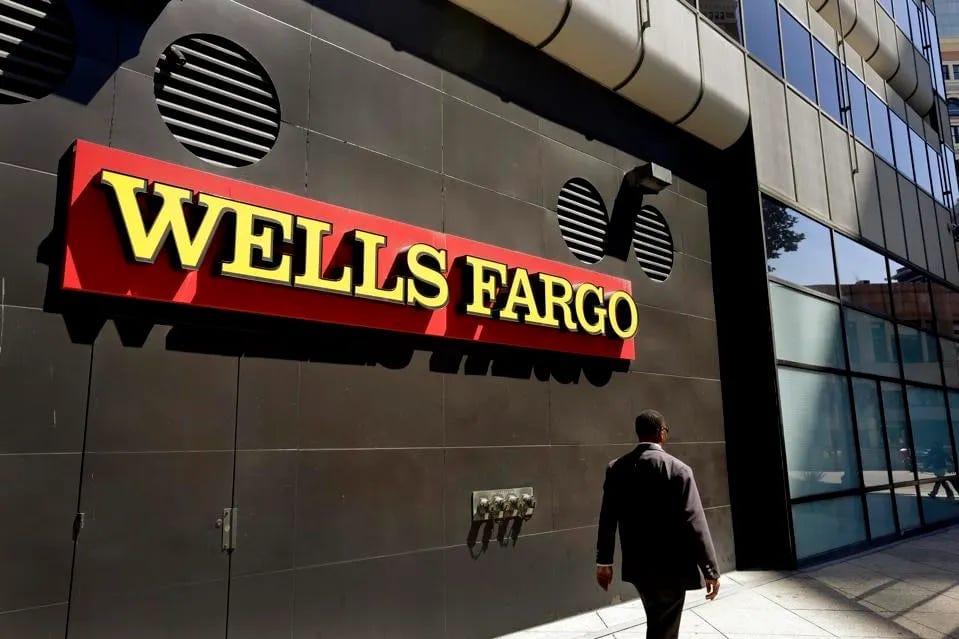
WELLS FARGO FINANCIAL FOOLISHNESS

2011 was a very bad year for Wells Fargo. The financial giant paid over $80 million in fines for upselling higher interest rate mortgages to customers who were able to receive lower rates. Such a severe penalty should change not only who is in leadership, but the broader organizational policies that led to such behavior. At least you’d think it should.

But less than ten years later, this was the headline:

$3 Billion Payment Result of Deferred Prosecution Agreement in Criminal Matter, Settlement of Civil Claims under FIRREA and Resolution of SEC Proceedings

Why? Because employees had been opening accounts (deposit accounts) for current customers–without customer approval. For several months, many employees were repeating the following formula…

  1. Open an account (without customer knowledge)

  2. Move in a little bit of money (also without customer consent)

  3. Close the account

  4. Put the money back (hoping customer didn’t see the whole process)

After opening enough accounts, employees received a bonus–an incentive to continue following the formula. Compensation and incentive programs often generate problematic employee behavior.

“Unfortunately, as variable compensation plans afford high-performers an opportunity to maximize their income, they can also come with many unintended consequences. From lawyers who paid their client billables, to the product sales reps who work in cahoots with buyers to shift the timing of purchases to help each hit their bonuses, these compensation models can be a driving force for behavior if not designed with extreme care.”—Forbes (2016)

In both cases at Wells Fargo, the rewards and incentives the company used to motivate employees to increase profitability eventually led to criminal behavior–massive fines–and lower profit.


dd7c8290-f48b-4f9e-892e-a96034e2ad7f_1928x1280.jpg
THE LIMITATIONS OF TRADITIONAL PROBLEM-SOLVING AND STRATEGY-BUILDING

Many organizations approach problems with what we might call a "mechanical mindset" — they see issues as isolated events that can be fixed with straightforward solutions. This approach works well for routine problems, where cause-and-effect relationships are clear and solutions are well-established. However, today's most pressing organizational challenges are adaptive in nature — they're complex, interconnected, and resist simple solutions.

Consider the case of Wells Fargo's account scandal. The surface-level solution might appear to be implementing stricter controls and changing incentive structures. However, this fails to address the deeper systemic issues within the organizational culture that allowed such practices to develop in the first place.


THE POWER OF SYSTEMIC INTELLIGENCE

SysQ enables organizations to better:

Frame up strategic objectives — Identify the most important trends and systemic relationship to improve

Model the business — Develop operational understanding…see the “physics” of the business…of how the business works

Solve problems and build strategy — Find high leverage solutions and strategies to fundamentally transform organizational performance

Implement and learn — Enroll across silos to better implement the strategy using key leading indicators to monitor and learn

Organizations with high SysQ are better equipped to navigate complexity and create sustainable solutions. They understand that quick fixes often lead to longer-term problems, and that lasting change requires understanding the whole system.

BUILDING SYSTEMIC INTELLIGENCE IN ORGANIZATIONS

Developing SysQ requires organizations to:

Challenge existing mental models and assumptions Look beyond immediate cause-and-effect relationships Consider multiple perspectives and stakeholder views Take time to understand problems before rushing to solutions

While tools like AI and data analytics can support this process, they cannot replace the fundamental need for systemic thinking.


e2187b13-f8ee-4c17-bc8b-d54cc69ab423_1928x961.jpg
THE RETURN ON INVESTMENT

Organizations that develop strong systemic intelligence capabilities will see:

  • More effective strategy development and execution
  • Better risk management and decision-making
  • Increased innovation and adaptability
  • Improved stakeholder relationships and outcomes

In a world where change is constant and challenges are becoming increasingly complex, systemic intelligence isn’t merely an advantage — it’s a necessity for organizational survival and success.

ORGANIZATIONAL APPLICATIONS

Many of us spend most of our lives working, often for organizations. As mentioned earlier, organizational challenges are numerous. These range from individual decisions within a division or department to strategic decisions made in c-suites with board input. These decisions are frequently made without adequate understanding of their potential impact on performance. SysQ is a capacity that enhances insight and impact.

The ORGANIZATIONAL APPLICATIONS are of the Finding High Leverage substack is dedicated to content specifically tailored to organizational challenges. We will explore a wide range of issues, including how to develop high-leverage strategies and reduce employee burnout. Use the Organizational tag to find articles and tools that describe how SysQ can enhance your effectiveness in any organization, regardless of its size or nature, such as a multinational Fortune 100 company or a nimble local philanthropic organization.

By • a year ago
💲Building Systemic Intelligence: How Deep Understanding Transformed Risk into Opportunity

“The framework, tools, and language of system dynamics should be accessible to all. Anyone can do this at some level, and everyone should try!” —Barry Richmond (developer of STELLA)

Picture a boardroom at a medical supply company, where executives are confronting a sobering financial reality. The manufacturers of their digital imaging systems – sophisticated machines that provide windows into the human body – are charging warranty fees that border on the astronomical. With equipment markups of 400% and warranty fees that rival the operating budget of a small research institution, the situation seemed untenable.
The executives faced a decision that would test their understanding of their own business system: Should they break away from the manufacturer's warranty protection and take control of their risk management?
The Strategic Challenge

Medical imaging equipment exists in a complex web of interconnections. Each machine serves multiple healthcare providers, who in turn serve countless patients. When a machine fails, it sends ripples through this entire system. While such failures are relatively rare, their impact cascades through the healthcare delivery network in ways that aren't immediately obvious.

The manufacturers understood this complexity – or at least its surface manifestation – and built their warranty pricing around it. But the executives wondered: Could a deeper understanding of their system reveal opportunities hidden beneath this surface-level analysis?
Building Systemic Intelligence

Rather than seeking a quick solution, the company made a pivotal decision: they would invest in building their capacity to understand complex systems. They engaged a system dynamics consultant who implemented what I consider the highest leverage approach possible: teaching the company's analytics team to see and understand the patterns and relationships that drove their business system.
ce538880-90e0-4097-a504-0c4944d29f13_2634x1503.webp
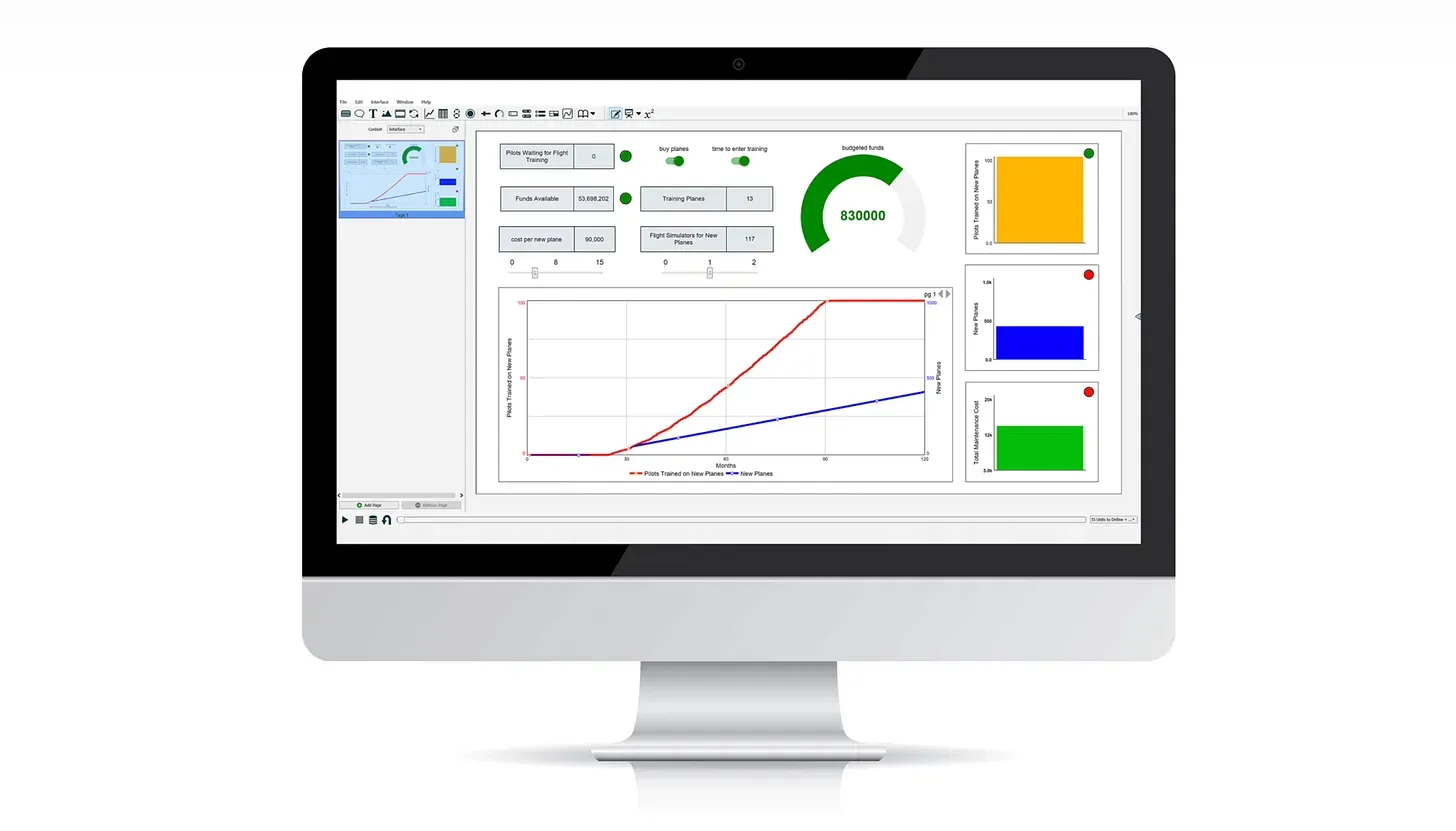
The team learned to use STELLA, a simulation platform that allows organizations to map and understand complex system behavior. Think of it as a laboratory where you can explore how different parts of your business interact and influence each other over time. This wasn't just about predicting failures – it was about understanding the deep structure of their entire business ecosystem.
38737287-08d2-41e1-ba94-27dd1b8ce663_3085x1843.webp

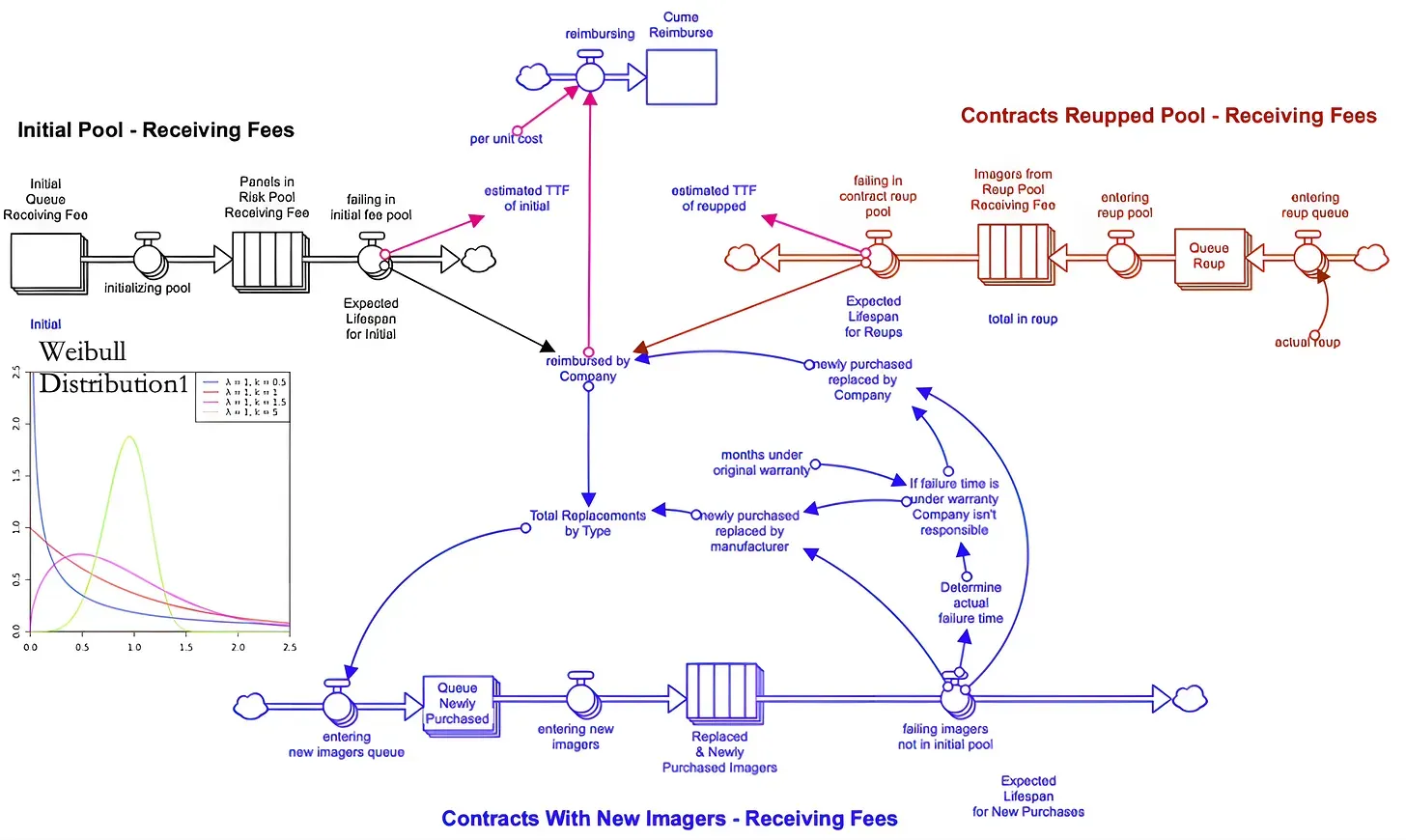
Mapping the System

The team began building what we might call a "system observatory" – a sophisticated way to understand how their equipment, customers, costs, and risks all interconnected. They looked beyond simple cause-and-effect relationships to understand the deeper patterns that governed their system's behavior.

They discovered that equipment failures weren't isolated events but part of larger patterns influenced by multiple factors: usage patterns, maintenance schedules, operator training, and even the healthcare facilities' operational rhythms. By mapping these interconnections, they began to see opportunities that remained invisible under traditional analysis.
a97495b9-9430-4b75-9143-2f98f15055cd_1600x1080.webp
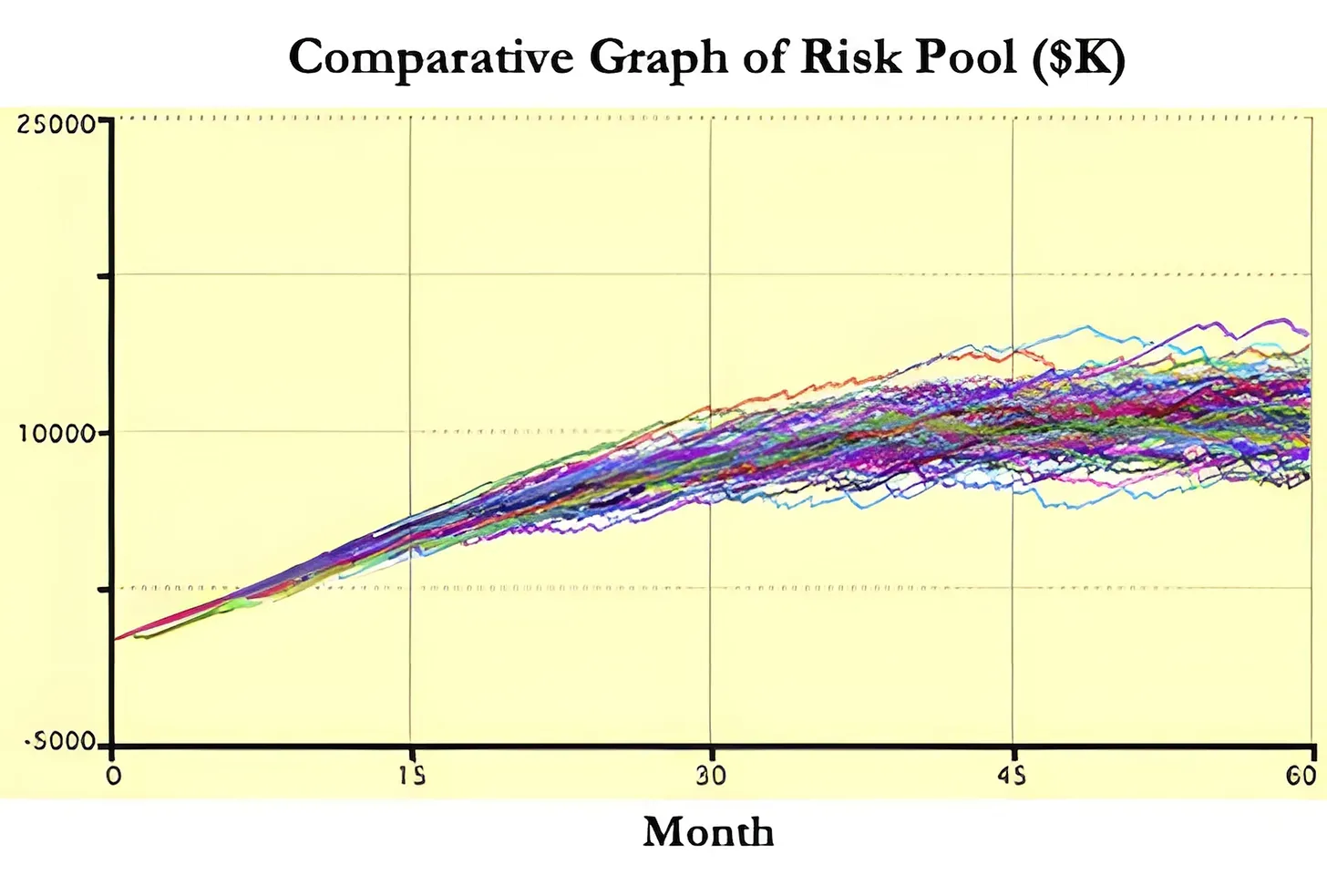
The simulation modeling revealed something surprising: the manufacturers' warranty pricing reflected a simplistic understanding of risk that ignored the system's natural resilience and self-regulating patterns.

When Understanding Meets Reality

The analysis indicated a clear opportunity, but the real test came in implementation. Within the first month, two imaging systems failed – a convergence of events that would have shaken less systemic thinking.

This moment perfectly illustrates the difference between surface knowledge and deep systemic understanding. The analytics team maintained their composure, recognizing these failures not as isolated disasters but as expected variations in a well-understood system. Their confidence came not from statistical calculations but from a fundamental understanding of how their system behaved.

Their confidence proved well-founded. By year's end, the company had captured over a million dollars in savings. These gains continued to accumulate as their understanding of the system deepened year after year.

Essential Insights

  • Build Understanding, Not Just Solutions:

    The decision to develop in-house system dynamics capabilities created a foundation for ongoing insights and improvements. The team didn't just solve one problem – they developed the ability to understand and solve future challenges.

  • Trust Deep Understanding:

    When early events seemed to challenge their strategy, their systemic understanding provided the confidence to maintain course. They knew the difference between systemic patterns and surface-level fluctuations.

  • Evolve with the System:

    The team's commitment to continuous learning ensured their understanding evolved as their business system changed and grew.

  • Share the Vision:

    Complex systemic insights became actionable through careful visualization and communication, enabling effective decision-making at all organizational levels.

6bc6c746-b348-4941-af62-2f971a48b823_1928x1280.webp

The Broader Perspective

This case transcends the immediate context of warranty cost reduction. It demonstrates how organizations can transform uncertainty from a source of anxiety into an opportunity for deeper understanding. System dynamics provides the framework for this transformation, enabling decisions based on genuine systemic intelligence rather than industry convention or surface-level analysis.

The million-dollar savings represent merely the quantifiable surface of a deeper change. The real achievement lies in developing an organization capable of seeing and understanding the complex systems that drive their business. This deeper vision reveals opportunities hidden from conventional analysis and builds confidence even in uncertain conditions.

This is the essence of high-leverage thinking in action – where systemic understanding, clear vision, and strategic insight converge to create lasting organizational value.

By • a year ago
⇶ Why Systemic Intelligence is Essential for Cross-Boundary Initiatives

"Attempting to foster systems change without building the capacity to 'see' systems leads to a lot of talk...and very little results." —Kania, Kramer and Senge

In today's interconnected world, most significant societal challenges span multiple boundaries - organizational, sectoral, geographical, and cultural. Whether we're addressing climate change, public health, economic inequality, or educational reform, success requires collaboration across traditional silos. Yet our conventional approaches to problem-solving often fall short when dealing with such complex, cross-boundary challenges. This is where Systemic Intelligence (SysQ) comes in; SysQ provides the ability to “see” systems — as Kania, Kramer and Senge assert — is essential to facilitate ecosystem transformation.1
THE CHALLENGE OF CROSS-BOUNDARY INITIATIVES

Adaptive leadership expert, Dean Williams, describes the challenge of working across silos.2

“Most people do not fully appreciate the systemic nature of their problems. We think and act parochially. The cultures of our respective groups and the respective roles we play in these groups often cause us to view problems through the narrow and myopic lens of immediate self- or group interest.”

—Dean Williams, Leadership For a Fractured World

Cross-boundary initiatives face several inherent challenges. Different organizations have their own goals, metrics, and ways of working. Supply chains involve multiple independent actors with competing interests. Public-private partnerships must bridge different organizational cultures and incentive structures. These differences often lead to unintended consequences, policy resistance, and failed initiatives.

Traditional linear thinking and simple cause-effect models prove inadequate because they fail to capture the complex reality of these situations. As we've seen, the real world is characterized by tight coupling between actors, feedback loops, nonlinear relationships, and adaptive behaviors. When we ignore these characteristics, our solutions often fail or even make problems worse.

COVID, SUPPLY CHAINS, AND INFLATION

The COVID-19 pandemic exposed critical vulnerabilities in global supply chains that a systemic intelligence approach could have helped anticipate and mitigate. When the pandemic hit, most organizations responded reactively - cutting production, reducing inventory, and laying off workers. These individual decisions, while seemingly rational from each organization's perspective, collectively amplified the system-wide disruption. A SysQ approach would have revealed how these local optimizations could create devastating ripple effects throughout the entire supply chain network.

By applying systemic intelligence principles, organizations could have better understood the crucial time delays and feedback loops in the system. For instance, the long delays in rebuilding production capacity and inventory levels meant that when demand suddenly returned, the system couldn't respond quickly enough, leading to shortages and inflation. SysQ tools like stock-and-flow mapping would have helped stakeholders visualize these delays and plan more resilient responses, such as maintaining strategic inventory buffers or investing in flexible production capacity.

Most importantly, systemic intelligence would have encouraged greater collaboration and information sharing across organizational boundaries. Instead of each company optimizing for its own survival, a systemic approach would have facilitated coordinated responses that considered the health of the entire supply chain ecosystem. This could have included joint investment in critical infrastructure, shared early warning systems, and collaborative capacity planning. The lesson from COVID-19 is clear: in our interconnected world, success requires not just organizational excellence but systemic intelligence to understand and manage complex inter-dependencies.


6e97cae1-1831-4ada-b4b1-92f4f0afab07_1925x1084.webp
Systemic Intelligence provides both the mindset and tools needed to navigate cross-boundary challenges effectively. Using SysQ you will be better able to:

Uncover and see hidden connections

SysQ helps us map and understand the complex web of relationships and feedback loops that span organizational boundaries. This prevents us from missing critical interdependencies that could derail our initiatives.

Anticipate and prevent unintended consequences

By explicitly considering feedback loops and nonlinear relationships, SysQ helps us identify potential negative side effects before they occur, allowing us to design more robust solutions.

Promote shared understanding and implementation

SysQ tools like causal loop diagrams provide a common language for stakeholders from different backgrounds to discuss complex systems and build shared mental models.

It identifies high-leverage interventions: Instead of treating symptoms, SysQ helps us find the root causes and points of leverage that can create lasting positive change across the entire system.


PRACTICAL APPLICATIONS

Consider these examples where Systemic Intelligence is crucial:

Supply Chain Transformation

SysQ reveals how changes in one part of the supply chain affect other participants, helping design win-win solutions that benefit the entire network.

Public-Private Partnerships

By mapping the different incentives and feedback loops affecting each partner, SysQ helps design more effective collaboration mechanisms.

Collective Impact Initiatives

When multiple organizations work together on complex social issues, SysQ helps them understand how their different programs and interventions interact and influence each other.

cae56040-eb7c-4686-b216-7b0245f1ff3a_1928x1280.webp
BUILDING SYSTEMIC INTELLIGENCE CAPACITY

To succeed in cross-boundary initiatives, organizations and leaders need to develop their Systemic Intelligence capacity. This involves:

  • Learning to identify and map feedback loops and system structures

  • Developing comfort with complexity and nonlinear thinking

  • Using tools that capture both "hard" and "soft" variables

  • Building shared understanding across organizational boundaries

As our world becomes increasingly interconnected, the ability to think and act systemically across boundaries becomes not just valuable but essential. Organizations and leaders who develop strong Systemic Intelligence will be better equipped to tackle complex challenges and create lasting positive change.

Without this capacity, we risk continuing to implement solutions that fail to address root causes, generate unintended consequences, and waste precious resources. With it, we can design more effective interventions that create positive change across entire systems.


INTER-ORGANIZATIONAL AREA

Because the world is rapidly complexifying, we need to collaborate across boundaries to address the knotted, interdependent problems we face. During COVID we were hoarding toilet paper from global supply chain disruptions. The lingering effects of this interdependent ecosystem continued for several years in the form of higher than normal inflation.

NGOs are finding they need to work in coalitions — often gravitating to collective impact processes — in order to address interconnected problems of well-being like health, housing, poverty, and racism.

Content with the Inter-Organizational tag will describe how SysQ helps orchestrate learning across boundaries. You’ll see how it helps improve working relationships with suppliers, contractors, and partner organizations. You’ll learn about how coalitions and collaboratives use SysQ to find greater leverage on important Societal issues.
1

Kania, Kramer, and Senge, The Water of Systems Change, FSG, 2018 https://www.fsg.org/resource/water_of_systems_change/
2

Williams, Dean. Leadership for a Fractured World: How to Cross Boundaries, Build Bridges, and Lead Change, Berrett-Koehler, 2015.


By • a year ago
Footer Logo

© Finding High Leverage 2025

Library

  • Application
  • Courses
  • Resources
  • System Sightings

Company

  • About
  • Contact
  • Membership
  • FAQ
  • Member Login

Social

  • Facebook
  • LinkedIn