
PROCESS

Attribute of Process
Start with the whole, then earn the details
About
Most analysts do it backwards. They dive straight into the data, pull apart the pieces, and try to build understanding from the bottom up — only to find themselves buried under complexity they can't escape. Barry Richmond called a different route: the high road. The systemic intelligence process begins at altitude, with boundaries drawn wide enough to hold the full performance story. Stocks, flows, a handful of loops — the simplest possible structure that could plausibly generate what you're seeing. Then, and only then, do you add detail — one layer at a time, just enough to close the gap between model behavior and reality. The discipline isn't knowing when to go deeper. It's knowing when to stop. The moment your map can reproduce the performance you're trying to understand, you have what you need. Not a perfect map. A useful one.

About
When I sit down with a team — a leadership group, a program staff, a community coalition — someone almost always says it within the first hour: "The devil's in the details." They mean it as a warning, or sometimes as a point of pride. Either way, it's usually where the conversation wants to go next.
I push back...gently.
Diving straight into the details tends to produce the opposite of what people are hoping for. More confusion, not less. More overwhelm, not more clarity. And almost never a real grasp of the structural forces actually shaping performance — whether that performance is a problem we're trying to solve or a success we're trying to understand and sustain.
What we need first is a useful mental model. By useful, I mean a model that explains why performance looks the way it looks. One that helps us visualize causes, not just feel the symptoms.
That's what the SysQ Process is built to do. We start at altitude — the high-level view of the system — and then add one layer of complexity at a time. A stock here. A feedback loop there. A delay we hadn't accounted for. Each addition earns its place by helping the team see a larger force at play that the previous picture couldn't explain. The details come back in eventually — but now they sit inside a structure that makes them make sense.

“Two roads diverged in a wood, and I — I took the one less traveled by, And that has made all the difference.” — Robert Frost
The Road Less Traveled
We tend to focus on the present moment. Most PhDs are awarded for studying a single weed in a field and analyzing it in great detail.
Good systems models, on the other hand, take a broader perspective.
They look at the big picture, analyzing long-term patterns and trends to find ways to improve things over time.
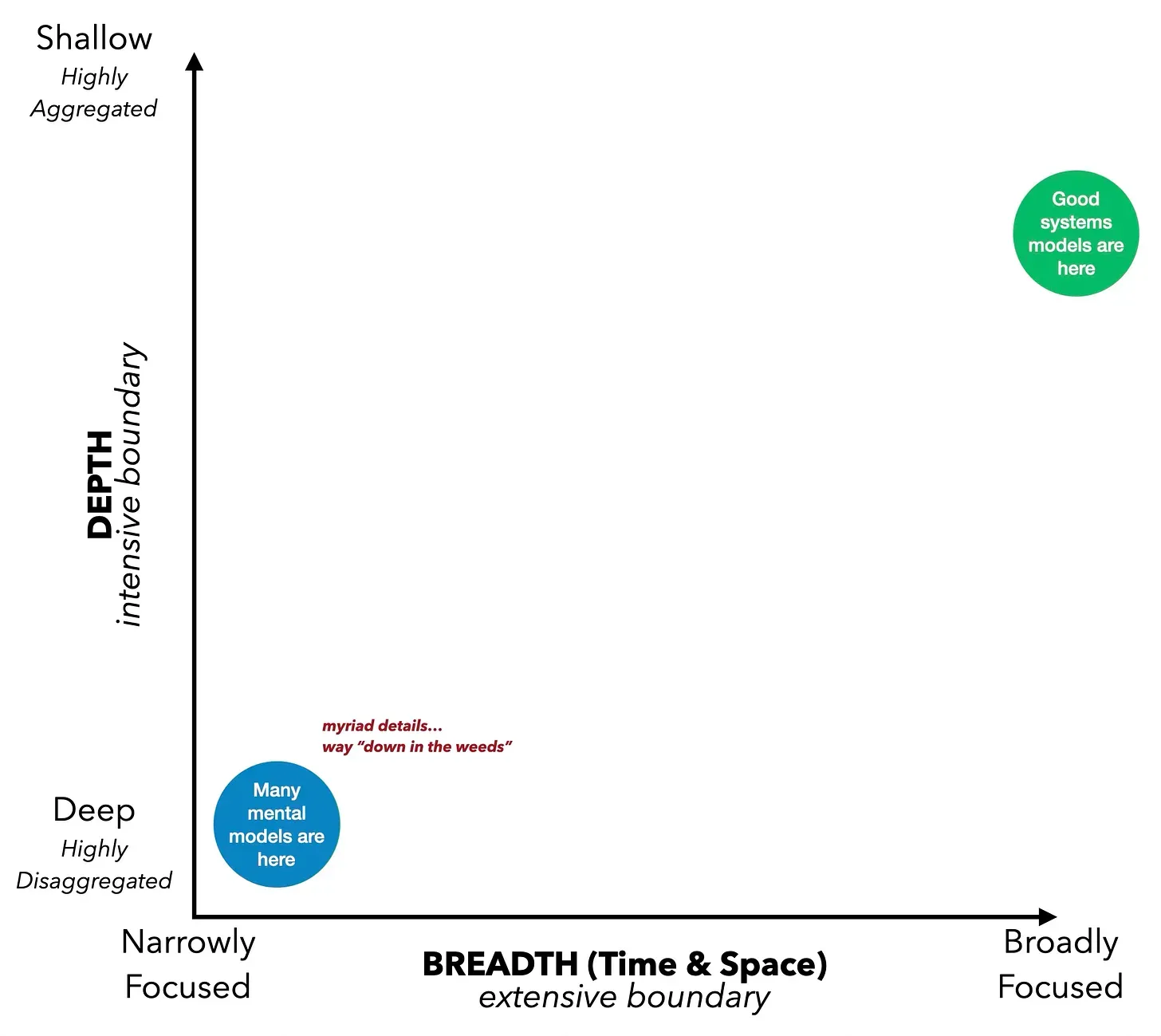
Most mental models are confined to a narrow window of time and space. We usually focus on a few days or weeks, while the system operates over years. Similarly, we usually concentrate on our department or division, but to effectively manage the system, we need to consider multiple organizations, agencies, groups, and stakeholders.
HOW DEEP (DETAILED)?
You may have heard that adaptive leaders should step back from the action and take a look at the big picture. It can feel like we’re stuck in the weeds, and it’s hard to see the shared values and beliefs that guide our interactions with others. Instead of focusing on individual differences, it’s helpful to apply a broader context (FOREST Thinking) — see how forces and conditions in the ecosystem shape our actions. Public health professionals deal with large numbers of people, while marketing departments manage diverse customer groups.
HOW TO BUILD GOOD SYSTEMS MODELS
Good systems models are in the upper right. They see broadly to understand the forces across the full ecosystem responsible for the performance issues you want to improve. The goal is to generate good systems models. The challenge? How to get there!
There are two roads we could take to reach the destination of a useful systems model.
Road 1: Representing the System
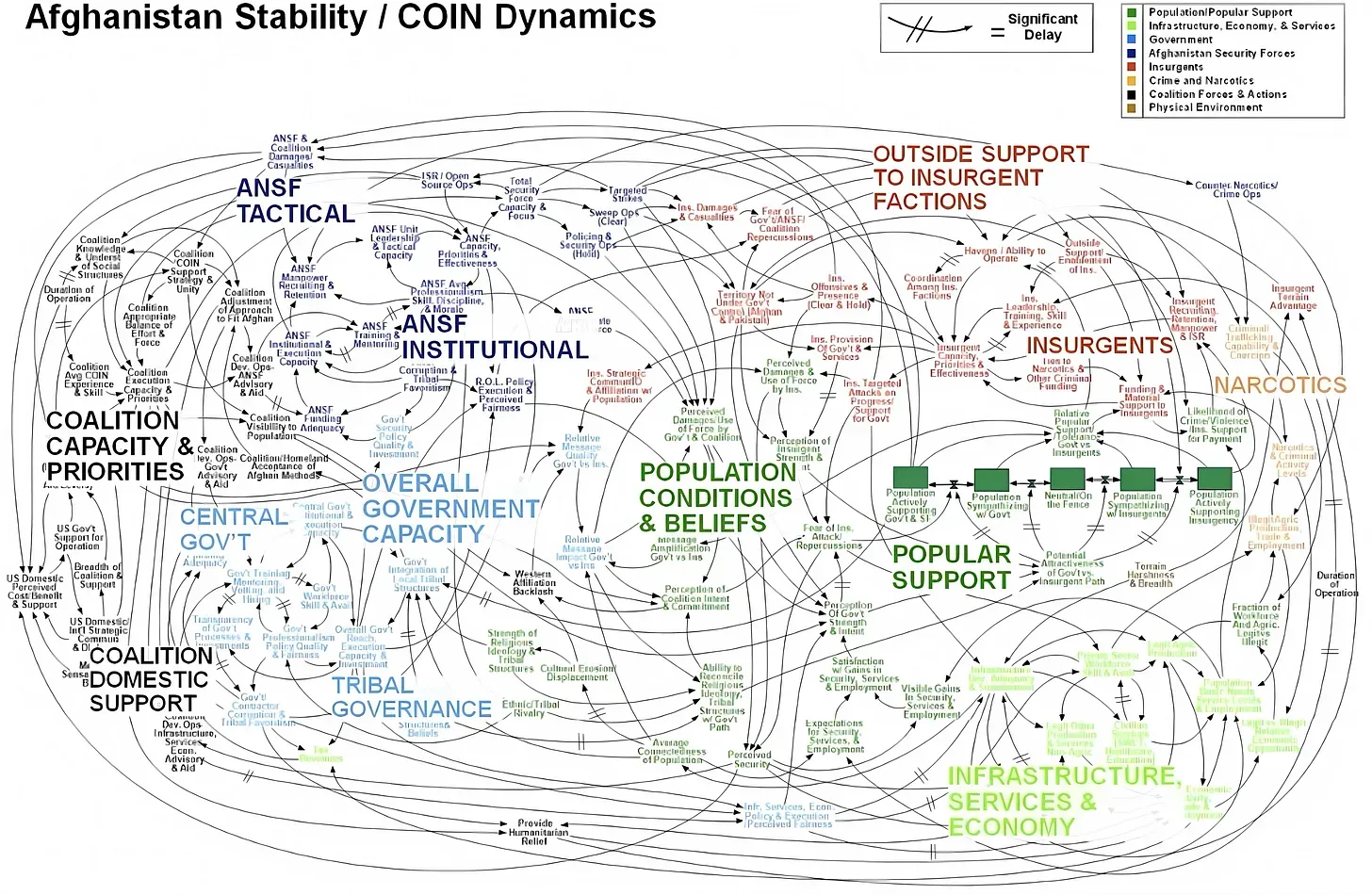
Road 1 is the most popular path. It tries to make a complete map of everything from the start. Teams of experts with specific knowledge often try to put all their knowledge together into a detailed picture. But this can make the map too complicated — like the Afghanistan Counterinsurgency map — with too much detail. This pursuit of a complete system map puts us on the Low Road (Road 1).
The Low Road starts with myopic perspectives and ideas and tries to put them together into a coherent whole. Since we have so much detail and the task is so big, this process only makes things more complicated. If we’re lucky, the mapping project ends up with a map as complex as the counterinsurgency map — a tangled web of information. More likely, the mapping effort stops, leaving us lacking comprehension and insight.
The problem is trying to map the whole system instead of just understanding the cause of the behavior (performance measure) we want to improve. Remember the slinky. If our performance goal is to significantly reduce the Slinky’s oscillation, we only need to focus on the physics of the spring. We can leave out colors and shapes — in fact, we must exclude them to reduce complexity. For usability, we must eliminate parts of the full system that don’t contribute to the performance we want to improve.
“Details are confusing.
It is only by selection, by elimination, by emphasis, that we get at the real meaning of things.”
—Georgia O’Keefe
Road 2: Get Up Out of the Weeds
Road 2 is the wisest path. It is the High Road path.1
The High Road starts by setting the big picture vision for system performance. Then, you can decide what you want to see improve. Next, you can build a simple causal map, pick and change a system archetype, or make a simulation model. These tools help you understand what causes that behavior.
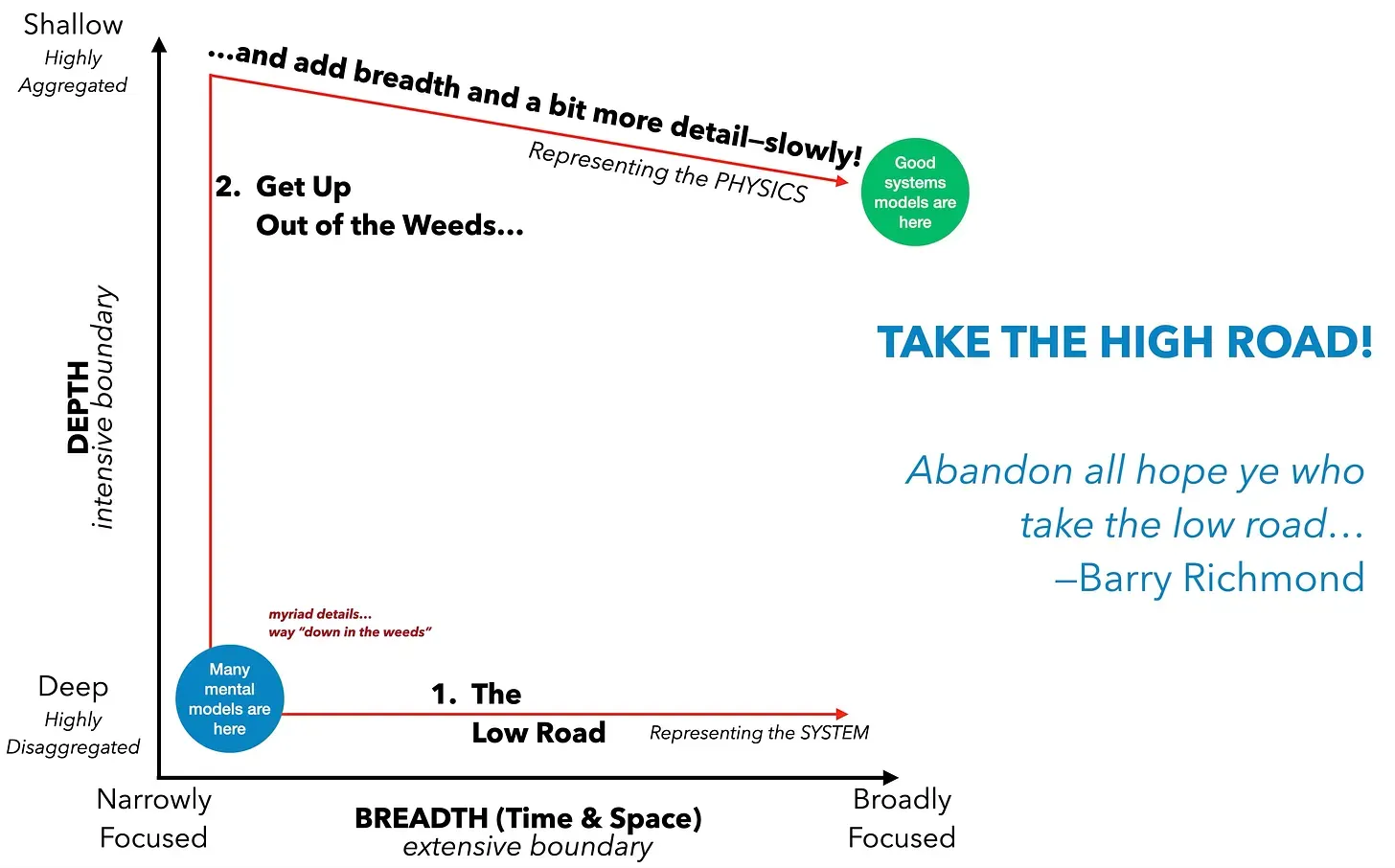 The High Road process involves sharing the initial “starter map” or “starter model” with others. Does it provide a clear explanation of why the performance issue is occurring? What changes or additions are needed? Make small adjustments and share the updated model for testing.
Keep adding more details a little at a time. This is the gradual descent in the diagram labeled “and add breadth and a bit more detail — slowly”.
Apply OPERATIONAL Thinking when adding more elements. Answer the question: “Does this contribute to the physics of the challenge — does it explain how the performance is generated?”
When you can finally answer the question “Does this describe the essential drivers of the performance issue?” with “Yes!”, it’s time to stop mapping (or whatever SysQ analysis process you’re applying.
Then use the map or analysis to start exploring ways to improve performance. You can look for solutions to close the future performance gap — you can find interventions to achieve your vision.
“A model should be as simple as possible, but no simpler.”
—Albert Einstein
The concept of two roads, and especially the High Road, was first developed by Barry Richmond (Dartmouth College) while teaching system dynamics to his undergraduate students. The concept was so memorable that one of his students years later asked me if I had a Powerpoint slide with the roads on it.
Additional Resources
Books
Book title as link | Description
Articles
Article title as link | Description
Online Resources
Resource title as link | Description

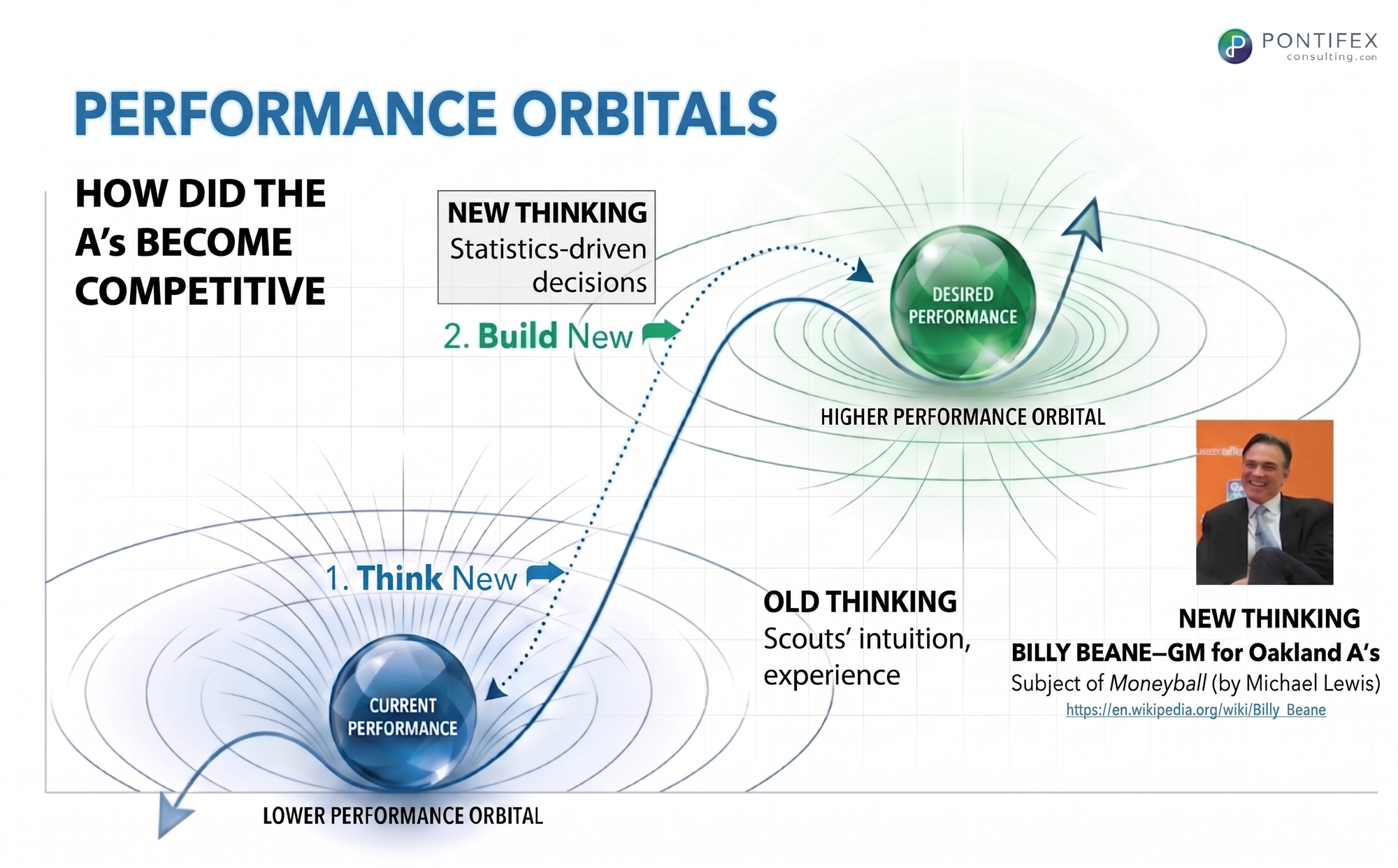
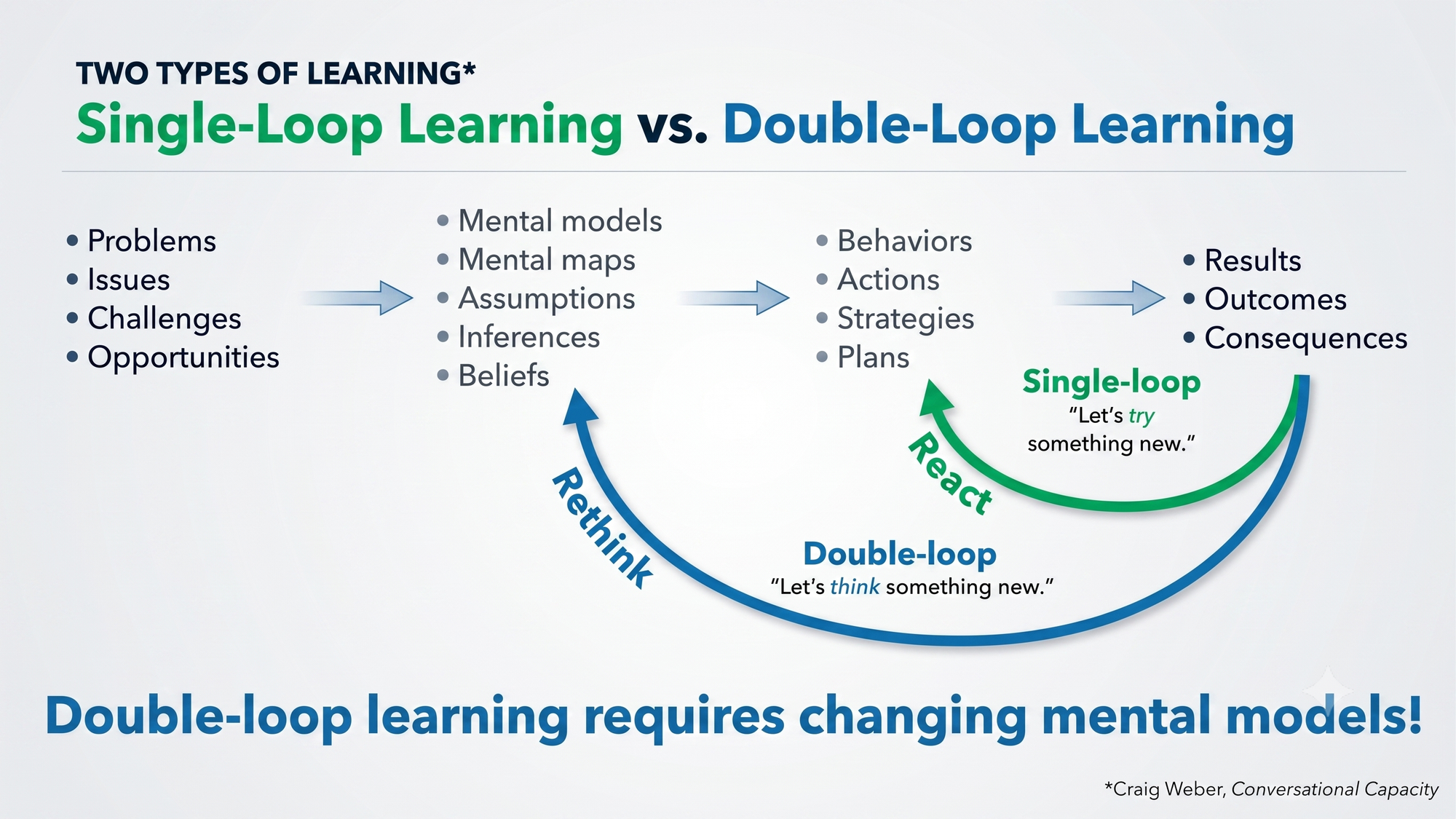

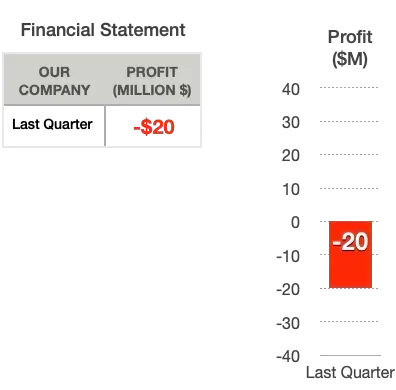 Bad, right? Worried?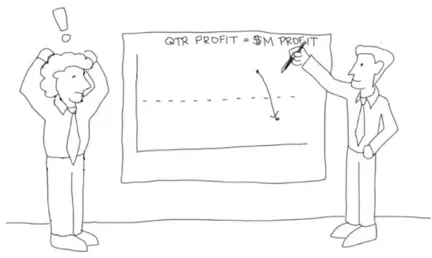
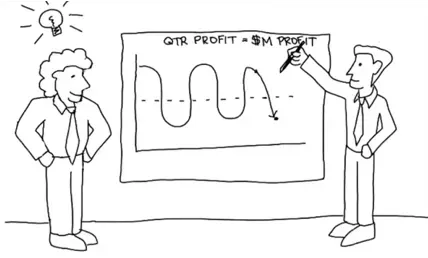 Now how do you feel?

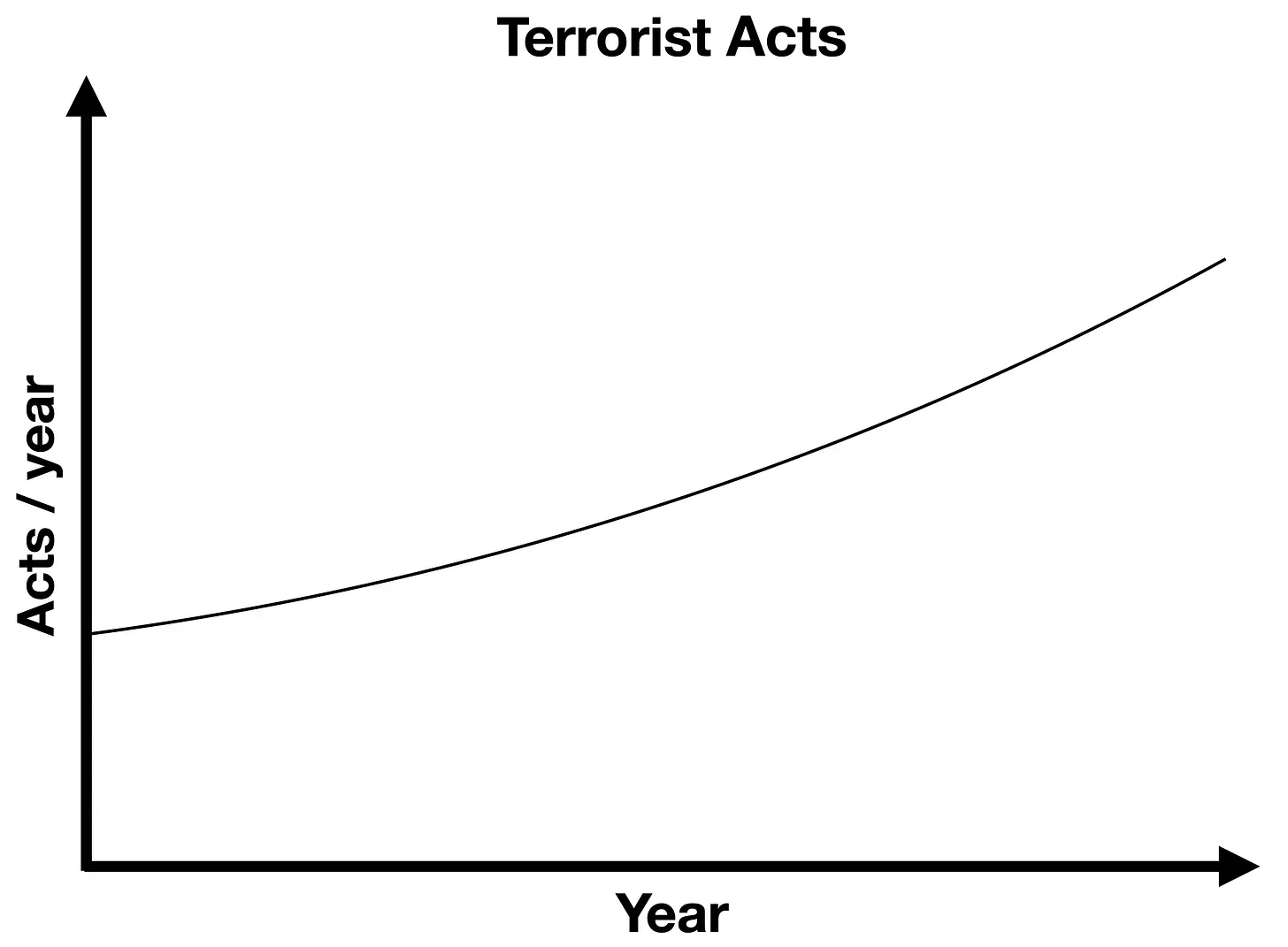
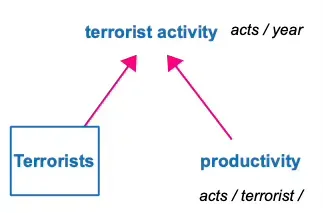 LINEAR Thinking would suggest that an intervention that kills terrorists would work to reduce terrorist activity. However, by applying FEEDBACK LOOP Thinking we can see it will likely kill people who are not terrorists; this will motivate more potential terrorists to enroll in terrorist organizations and eventually be trained to commit acts. This would create a nasty reinforcing feedback loop (R1) known as a vicious cycle.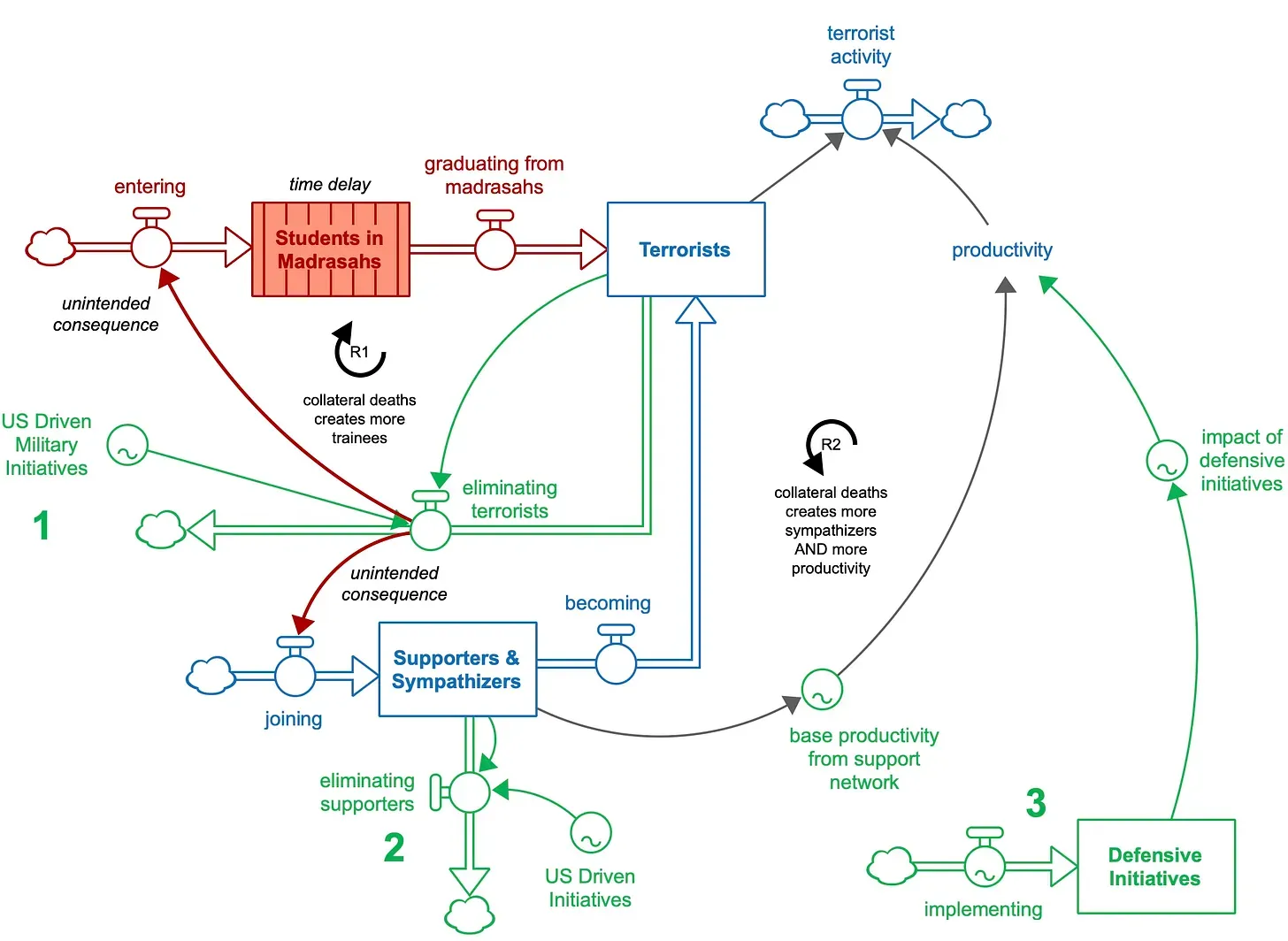

 To truly improve a situation, we need to understand the underlying forces driving the problem. Often, we jump straight into solutions without fully grasping the root cause. A common mistake is assuming we know what’s causing a problem and moving on to the next step.
